10.14.2010

Russell Brand on Fame, Idolatry, and God

Say what you will about Brand (I happen to love him), but this interview is undeniably riveting, overflowing with terrific and sometimes absurd soundbites about the modern religion of celebrity, the universality of the Law (secular and sacred!), moral questions of motivation and spontaneity, the problem of control when it comes to things like legacy and the media, and the human need for God, not to mention some characteristically inspired nonsense. Perhaps a little coked-out, but I'm willing to give him the benefit of the doubt, out of the sheer entertainment value if nothing else (ht CE & JM):


Labels: , , , , ,

9.20.2010

Martin Sheen talks about God

I ran across this interview with Martin Sheen and Emilio Esteves about their new movie called The Way, about the famous 500 mile Jacob's Way pilgrimage from from the French Pyrenees to Santiago de Compostela, which had some wonderful bits about religion and spirituality and the intersection of the two. Here is the final section:

I really appreciate that you're trying to deal with religion and spirituality in this movie in an open-minded, non-cynical fashion, without totally embracing it or totally rejecting it. That's a difficult thing to do. Our country is so messed up around religion.
M.S.: No kidding! [Laughter.]
I know -- what a brilliant observation, right? But you guys call our attention here to a tradition of Western spirituality that runs deep in our European roots and has very little to do with organized religion. The Camino de Santiago is a perfect example. I feel like so many educated Westerners go toward the Eastern spiritual traditions partly because they don't see that or understand it.
E.E.: Sure, they want a response to the dogma of Christianity. They go to Hinduism, they go to Buddhism, just because it's something different than their parents. They want to get away from that. I think it's a knee-jerk reaction.
M.S.: Religions separate us, by their very nature. Spirituality unites us. That's the key, and if spirituality is not about humanity, it's not spiritual. I am a practicing Catholic. I love the faith. I'm not nuts about the institution, but the faith is mine, everywhere I go in the world. The belief that God became human -- that's genius, man. And that God would choose to dwell where we would least likely look, inside ourselves and each other. The genius of God in our humanity, I love that.
Every culture has that -- the Hindus, Muslims, all of them have it. That's the fundamental belief in all true believers, that God is present, God suffers and is broken with us. That's why the Catholics never removed the corpse from the cross. Our hero is a convicted criminal. He was tried and convicted in a kangaroo court and then he was murdered. That's God. We're embraced by that. The most fundamental, most basic, most sincere beliefs -- that's not religion. It's spirituality. It's transcendence. People are looking for transcendence now more than ever, I think. Sometimes our transcendence becomes drugs, alcohol, money, power, sex, and they're so shallow. It's we ourselves, we must surrender ourselves to our brokenness. That's the beginning of community, and that's what this film is all about.
Some beautiful theological insights from an unlikely source, but one wonders what Hindu and Muslim theologians he is reading. While there are conceptions of life, death and rebirth in many religions, there is only one that puts an incarnate, crucified God at its center. In fact, one could argue that in the Jesus we see the death of "generalized spirituality," as few things could be less "transcendent" than a crucifixion, but we get what he's saying, and his theological reflections have raised the bar from what we have come to expect from Hollywood. . . I can't wait to see this movie.
[CONTINUE READING]

Labels: , , , , ,

9.15.2010

Woody Allen on Faith, Media and Happiness

The NY Times interviewed Woody Allen about his new film You Will Meet A Tall Dark Stranger, and he had some characteristically thought-provoking (and gloomy) things to say. Nothing we haven't heard from him before, but nonetheless notable:

Q. The ideas of psychic powers and past lives, or at least people who believe in them, are central to your latest film. What got you interested in writing about them?

A. I was interested in the concept of faith in something. This sounds so bleak when I say it, but we need some delusions to keep us going. And the people who successfully delude themselves seem happier than the people who can’t.* I’ve known people who have put their faith in religion and in fortune tellers. So it occurred to me that that was a good character for a movie: a woman who everything had failed for her, and all of a sudden, it turned out that a woman telling her fortune was helping her. The problem is, eventually, she’s in for a rude awakening.

Q. What seems more plausible to you, that we’ve existed in past lives, or that there is a God?

A. Neither seems plausible to me. I have a grim, scientific assessment of it. I just feel, what you see is what you get.

Q. How do you feel about the aging process?

A. Well, I’m against it. [laughs] I think it has nothing to recommend it. You don’t gain any wisdom as the years go by. You fall apart, is what happens. People try and put a nice varnish on it, and say, well, you mellow. You come to understand life and accept things. But you’d trade all of that for being 35 again. I’ve experienced that thing where you wake up in the middle of the night and you start to think about your own mortality and envision it, and it gives you a little shiver. That’s what happens to Anthony Hopkins at the beginning of the movie, and from then on in, he did not want to hear from his more realistic wife, “Oh, you can’t keep doing that — you’re not young anymore.” Yes, she’s right, but nobody wants to hear that.
...
Q. Were you prepared for the firestorm of media coverage you set off by casting Carla Bruni-Sarkozy in your next movie, “Midnight in Paris”?

A. I was very surprised at the level of journalism that occurred in relation to her. She has a small part in the movie — a real part, but it’s a small part. And I shot with her the first day, and then all the papers said she was terrible, and I did 32 takes with her. Of course I didn’t even do 10 takes with her. This was just a magical number that some guy created in a room. Then they printed that her husband came to the set and was angry with her. He came to the set once, and he was delighted. He felt she was a natural actress and couldn’t have been happier.

Q. That would make a good blurb for the movie poster.

A. For some reason, the press wanted to say bad things about her. I don’t know if they had something against the Sarkozys, or it was a better way to sell papers. But the fabrications were so wild and so completely fake, and I wondered to myself, Is this what happens with Afghanistan and the economy and matters of real significance? This is a trivial matter. That’s a longwinded answer to your question: I was not prepared for the amount of press that was attached to the picture because of Madame Sarkozy.

*Woody's on pretty solid ground here, at least according to the recent study by The National Academy of Sciences, "High Income Improves Evaluation of Life but Not Emotional Well-being." Buried in that document is the utterly fascinating finding that religious belief is correlated to happiness, but not to lessening worry. Anyone care to hazard a guess why? The report also claims that $75k is the salary mark at which happiness peaks. That is, according the write-up in the Times, "beyond household income of $75,000 a year, money 'does nothing for happiness, enjoyment, sadness or stress' - another entry for the already over-stuffed everyone-knows-but-no-one-believes file.

P.S. If you missed Woody Allen interviewing Billy Graham the first time we posted it, today is the day you correct that mistake. [Videos now working again!]

Labels: , , , , ,

9.13.2010

Jonathan Franzen on Growth

Pretty phenomenal soundbite from the Freedom author, being interviewed on NPR's Marketplace: 

"We have this notion in this country, not only of endless economic growth but of endless personal growth. I have a certain characterological antipathy to the notion of we're all getting better and better all the time. And it's so clearly belied by our experience. You may get better in certain ways for 10 years, but one day you wake up and although things are a little bit different, they're not a lot different. And I think if one can get more accustomed to that somewhat more tragic view of life, that people would think yeah, 'We don't actually need to have a bigger and bigger house, and a bigger and bigger car, and more and more things in the house.' That there might some way to think of the world in different terms, so it was more about being and less about growing."

Labels: , , ,

8.24.2010

David Foster Wallace on Fear, Achievement and Internal Means

One last quote from the book-length interview Although Of Course You End Up Becoming Yourself, after which I promise to give the St. Dave stuff a rest:

That the fear is the basic condition, and there are all kinds of reasons for why we're so afraid. But the fact of the matter is, is that, is that the job that we're here to do is to learn how to live in a way that we're not terrified all the time. And not in a position of using all kinds of different things, and using people to keep that kind of terror at bay. That is my personal opinion.

Well for me, as an American male, the face I'd put on the terror is the dawning realization that nothing's enough, you know? That no pleasure is enough, that no achievement is enough. That there's a kind of queer dissatisfaction or emptiness at the core of the self that is unassuageable by outside stuff. And my guess is that that's been what's going on, ever since people were hitting each other over the head with clubs. Though describable in a number of different words and cultural argots. And that our particular challenge is that there's never been more and better stuff comin' from the outside, that seems temporarily to sort of fill the hole or drown out the hole.

Could it be assuageable by internal means also?

Personally, I believe that if it's assuageable in any way it's by internal means. And I don't know what that means. I think it's fine in some way. [Tape off again; we keep turning it off while he mentally drafts and redrafts answers.] I think its probably assuageable by internal means. I think those internal means have to be earned and developed, and it has something to do with, um, um, the pop-psych phrase is lovin' yourself.

It's more like, if you can think of times in your life that you've treated people with extraordinary decency and love, and pure uninterested concern, just because they were valuable as human beings. The ability to do that with ourselves. To treat ourselves the way we would treat a really good, precious friend. Or a tiny child of ours that we absolutely loved more than life itself. And I think it's probably possible to achieve that. I think part of the job we're here for is to learn how to do it. [Spits with mouthful voice into cup.] I know that sounds a little pious.

Labels: , , , ,

8.09.2010

David Mitchell on Power, Events and Agency

A few soundbites from the masterful author's recent interview with The A/V Club, in support of his new The Thousand Autumns of Jacob De Zoet. We strongly recommend his work, esp Cloud Atlas and Black Swan Green, to all "students of the human condition":

AVC: You do seem to continue looking at exploitation, inequality, and people kept in place by their lack of economic and social power. Is it safe to say that’s an ongoing theme in your work?

DM: It’s a fair notation.

AVC: It certainly isn’t a theme that’s going to lose relevance anytime soon.

DM: [Laughs.] That’s true. I’m trying to think of a sophisticated answer, but I’m not sure I can! As you said, for one, it’s universal—the theme of power, or lack of it. If the human condition were the periodic table, maybe love would be hydrogen at No. 1. Death would be helium at No. 2. Power, I reckon, would be where oxygen is.
---------------
AVC: There’s a line near the end of the book, by the Captain—“Power is a man’s means of composing the future, but the composition has a way of composing itself”—that really brought that out.

DM: What you say reminds me of something British Prime Minister Harold Macmillan was asked: Who or what was in charge of the world, who made the big decisions in national and international political life? Harold answered: “Events, dear boy, events.” [Laughs.] Events are in charge! Isn’t that a great thing to say? It’s the health bill, it’s the invasion of Kuwait, it’s North Korea rattling its possible nuclear saber. It’s a war here, it’s an earthquake there—it’s events that are in charge.

Labels: , , ,

7.09.2010

Mary Karr Discusses "Lit"

This one comes to us by way of MB contributor Emily. I think it's safe to say that Mary Karr is a fellow Mockingbird, whether she knows it yet or not! Her life story reminds me of another MB favorite, Brennan Manning (author of "The Ragamuffin Gospel"), of whom it's been said that the Lord allowed him to walk through dark valleys so that he could later lead others to the Light.

Labels: , , , ,

5.17.2010

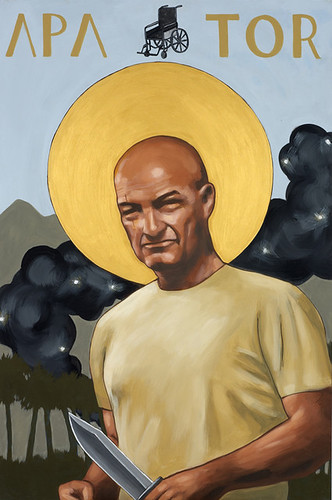
An Interview with the Writers of LOST

A few MB-related highlights from a recent New York Times interview with LOST writers Damon Lindelof and Carlton Cuse. If you are interested in the show at all, the interview is worth the full read.

On their literary influences:
"One of the things that we completely own is that in many ways “Lost” is a mash-up/remix of our favorite stories, whether that’s Bible stories from Sunday school or “Narnia” or “Star Wars” or the writings of John Steinbeck. Carlton and I both had to take philosophy classes when we were in college, and we talk about philosophy, so when certain ideas started to present themselves on the show, we just wanted to let the audience know that these philosophers are in our lexicon as storytellers."

On the final season’s religious emphasis:
"We view each season of the show like a book in a series, and so last year was the time travel book, and that story had a beginning, middle and end. This season is significantly spiritual. We felt the mission of the final season of the show was to bring the show full circle. And that if we were going to be discussing what was really important to us, which was how do these characters’ journeys conclude, that journey is a spiritual journey."

On the most important theme of the series:
"If there’s one word that we keep coming back to, it’s redemption. It is that idea of everybody has something to be redeemed for and the idea that that redemption doesn’t necessarily come from anywhere else other than internally. But in order to redeem yourself, you can only do it through a community." [Note: As seen below, there's a bit of a paradox here that's probably worth exploring...]

On the show “Constant” in season four:
"Nobody can do it alone. Desmond was unhooked or lost, he was a castaway bopping around through time, and his only possible salvation was finding the woman that he loved and telling her so and saying, “I need you to rescue me because I’m lost.” This fundamentally tapped into every single theme of the show."

If you haven't already, check out Ethan's great write up about LOST.

Labels: , , ,

3.30.2010

Whoops! Is My Elevated Anthropology Showing?

From the current Vanity Fair interview with Joel Osteen, the mega-pastor of America's largest church:
“Have you ever sinned?”

“Oh, sure,” [Osteen] answered surprisingly. “I’m sure I have. I mean, I think we’ve all sinned, so I can’t say that I’ve never … ” He looked suddenly bashful. “I’ve never done anything you’d call ‘terrible.’ I haven’t done drugs. Victoria’s the only girl I’ve ever dated.” Victoria, his glamorous wife of 22 years, is also a pastor. “I’m probably squeaky clean—I don’t have to say it,” Mr. Osteen added.
One's anthropology, theologically speaking, is one's doctrine of man. (See the Mockingbird-approved definition here.) The concept covers lots of territory. But the key question here is, in relation to God, what is a human being capable of? Is a human being able to please God? Osteen's response indicates a pretty robust sense of his own abilities towards righteousness (i.e., a high anthropology), and a shockingly lightweight view of sin. It appears that to him, sin is simply bad things we do, and thus can simply stop doing. The fact that anyone could be acquainted with the Bible (Romans 3, anyone?), and a pastor to boot, and still think of himself as "squeaky clean" is stunning. Because if one can be squeaky clean, what need does one have for (as the old hymn goes) a fountain fill'd with blood?

Jesus never said, "Be squeaky clean." Rather, he said, "Be perfect as your heavenly Father is perfect." And that's why I'm so glad for Good Friday.

Labels: , , ,

11.30.2009

Another Reason To Buy Bob Dylan's Christmas In The Heart

From an interview he did with the North American Street Newspaper Association last week in support of Christmas In The Heart. The entire interview is very much worth reading, but for our purposes, the clear highlight is:

Interviewer: You really give a heroic performance of O’ LITTLE TOWN OF BETHLEHEM. The way you do it reminds me a little of an Irish rebel song. There’s something almost defiant in the way you sing, “The hopes and fears of all the years are met in thee tonight.” I don’t want to put you on the spot, but you sure deliver that song like a true believer.

Dylan: Well, I am a true believer.


p.s. This morning Mardecortesbaja began their track-by-track breakdown of the record. Great stuff!

Labels: , , , ,

11.26.2009

Exclusive Interview: Mark Galli of Christianity Today (pt. 2)

Last week we posted part 1 of Mockingbird’s exclusive interview with Mark Galli, Senior Managing Editor of Christianity Today. Galli’s experience—from local pastor, to magazine editor, to columnist, to author—has all reflected and informed his passion for a cross-centered, true-to-life articulation of the Gospel. Part 2 of the interview explores Galli’s view on transformation in the Christian life, the place of spiritual disciplines, and the future of Evangelicalism. Enjoy!

Mockingbird: Earlier you pointed out the tendency among Evangelicals towards activism, an “addiction to the horizontal.” As someone who’s been in the Evangelical world for a long time, do you see connections between the current activism (for example, in the Emergent Church movement) and earlier similar movements (like the Jesus people in the 1960s and 1970s)?

Well, certainly emergent folks like to think of themselves as breaking away from Evangelicalism, but there’s so much about their movement that’s just a new chapter of an old book. And actually, not even a new chapter, but a repeat of a lot of evangelical characterizations.

For example, first of all there’s the rejection of the establishment (which in their case is Evangelicalism) and second there’s this notion that somehow they can create a fresh a way of doing church that is somehow more biblical or authentic (which is another Evangelical assumption about the world), and third, that they’re very activist, that they’re going to go out and change the world. Now in this case, they’re not interested in evangelism as much as they’re interested social justice. But it’s very much about getting their hands dirty in the world, and doing something for Jesus. So in that regard, the emergent movement is very Evangelical. And of course, they’d be shocked and appalled to hear that, but that’s my take on their movement.

Unfortunately, the leaders of the emergent movement have pushed that envelope so far that I really can’t tell much difference between what they’re doing and nineteenth century liberalism, which led to dismal results, as far as I’m concerned, for the life of the church. I’d be happy to have a conversation with them about that.

As far as the contrast with the 1960s and 1970s, you do see this youthful idealism that says, first, there are things that are seriously wrong with the church and with Christianity as it is understood today; and second, we can do something about it.

Now, it seems to me that if a younger generation isn’t feeling those things there’s something seriously wrong with that generation. I don’t want to discourage younger Evangelicals from shaking their fists in anger at the sins of the church and their passion to want to make a difference.

What I’m concerned about of course, is the hubris that sometimes comes with that. It can make it all about us, and our reformation and our ability to make a change in the world, instead of pointing us to a couple of other realities. And the first of those realities, what we have to remember, is that the moribund, horrible, sinful, selfish, hypocritical, televangelist church, the one who is co-opted by technology and growth and all these things we find despicable is the church that Jesus died for. And it is the church that Jesus is so committed to that he is willing to have his name associated with it, with that church, with that group of people who we all find disgusting and frustrating and aggravating and hypocritical and so nominal.

Earlier you mentioned the current Christian buzzword, “transformation”; another big one now is “discipleship.” We see these emphases in the wider Christian subculture, and again, in parts of the Emergent Church movement. One Emergent pastor I’ve read has said “the gospel is not that Jesus died for your sins, but that God wants you to help him transform the world.” How do you understand transformation for Christians?

We have to maintain a realistic sense of what we mean when we talk about changing things and transforming things: what is it that we can accomplish this side of the kingdom and what can’t we. Because of course, if you enter into the fray with these grandiose notions that you’re going to be able to transform the whole world and your own church, you’re going to run into brick wall after brick wall after brick wall because of original sin. And you’re going to either do one of two things: you’ll either imagine you’re making a difference when you’re really not, just to self-justify your efforts; or you’re going to become so discouraged that you’re going to give up altogether. And neither of those are Christian responses: one is hypocrisy and one is despair.

But the Christian always lives by hope, even in the most miserable of situations. Because he lives by Grace, he doesn’t live by his achievements, or his successes. He lives by the call of God on his life. So in that regard, back to your earlier question, this generation is like the generation of the 1960s, very idealistic, very passionate, very activist—but I’d like to bring in this emphasis on grace and humility back to the center.

What place is there for things that we call spiritual disciplines and what do they look like? It seems that the standard program in Evangelicalism is read your Bible more, pray more, journal more, get some accountability and you’ll get better. And you have said in your articles that often people don’t get better, at least not in the way we think, and the more we focus on our problems, the worse they get. How would you respond to the cry for spiritual disciplines? What’s a healthy way to think about that?

In light of the new thinking I’ve been doing recently, I’m having to rethink how I understand that. But I think the way I’d approach it now, the spiritual disciplines are at some level means of grace. God knows that we are weak and foolish and hard-hearted people. And he not only condescends to become human for us, but he uses elements of his creation in order to teach us about who he really is and what our relationship with him really is like. So spiritual disciplines are more about God’s means of helping us grasp what the Gospel is really all about and how he in fact does transform us. But what’s happened to a lot of the spiritual discipline language is that it not about teaching us who God is and how he shapes us, but it’s about getting transformed. It becomes about us.

One of Dallas Willard’s earlier works talks about the “spirit of the disciplines,” understanding how God changes lives. And there’s an emphasis that these are classic disciplines that have grown up in the church as a result of the leading of the Holy Spirit that have been instrumental—used by the Holy Spirit—to shape us.

But nowadays, you read books on spiritual formation with titles like "Spiritual Disciplines: Practices that Transform Us" and "Arranging our Lives for Spiritual Transformation." They’re all about us. And that’s where the emphasis has gone askew in the spiritual discipline world. Jesus, of course, talked about prayer and fasting, and was a regular attender of the synagogue (so he obviously attended worship, he listened to preaching and the reading of scripture). So all these are means by which a person is shaped and formed by God. But that is the point. And they will in fact have that affect. They will shape us and change us. If they don’t, something is fundamentally wrong. But that isn’t why we enter into them or what they’re about when we start them. It’s more about trying to enter into a human work/activity—prayer, Eucharist, preaching, Bible study—that opens us to the wonders of God’s grace.

I heard a sermon once where the preacher said that we need to clear things out of our lives, so that God can come in. And I said “Wait a second, if God wants to come in, He can.”

Exactly. He comes in people’s lives that are pretty darn cluttered.

I don’t think St. Paul cleared the road for Jesus to convert him. But often among Christians we talk about spiritual disciplines as if we are the only actors. But in reality, God is much more interested in your heart and soul than you are, and is probably already doing lots of things that you may or may not be aware of. He is disciplining you spiritually apart from anything you do.

Right. The very fact that you even have any desire to do spiritual disciplines might be a prompting of the Spirit in the first place. You’re not offering something up on your own initiative.
One example might be fasting. People talk about fasting in the terms you’ve talked about—clearing out space in our lives for God to enter in. For me, fasting is a physical parable that reminds me of how much of my life is focused on things that are non-God. Which is probably why I don’t do it very often. Fasting is something that always brings me to my knees in repentance. If it opens me up to God, it’s only because I recognize that I’m a person who’s not very open to God. And I think that’s true of all the disciplines on some level.

Last question: what are the bright spots in the Evangelical world? When you think about the future, what encourages you or gives you hope in light of all the muddled theology out there (a lot of which is pretty depressing)?

Well, I do think the neo-Calvinist movement is a hopeful sign. Everyone, when they talk about what young people are into these days, they’re always pointing to the radical emergent crowd. But when you actually look at the number of young twenty-something people who are actually going to church, or going to conferences, and giving their money to things, a huge number are in the Reformed crowd. I think they’re hungry to hear the message of the sovereignty of God, the prevenience of Grace. All the classical Christian understanding of the world. And the Reformed are really good at making that point. And they’re doing it really well right now.

The problem with a lot of the neo-Reformed movement is that they turn Grace—and you read some of the blogs, etc.—they turn Grace into a new Law. And they’re very judgmental and very critical of people who don’t talk about the Gospel in exactly terms they think it should be talked about. And they’re very quick to judge and to cast people off into outer darkness. This is the great weakness of the Neo-Reformed movement, as I can see it. But I nonetheless still think it’s a hopeful sign because it puts the emphasis on the right place: that it’s about God, first and foremost.

The other thing that’s a helpful movement, but could move in one of two directions, is the Ancient-Future movement. When people are trying to draw on the resources of Church historic, especially the early church fathers, and the church tradition that’s found in Catholic and Orthodox (and Anglican) circles, I think that is helpful, as long as it’s not being turned into a new traditional-ism, or it’s turned into a new religion. But drawing on the theological and ecclesial resources that the Church has offered us, that God has given to the church through the ages, has the potential to bring the Evangelical movement a more even keel and a breadth and a depth that could help sustain it in the decades ahead.

Of course, that’s just speaking on human level about two movements I tend to have some hope for. But in fact, in the end I really don’t care if Evangelicalism survives or not, as we know it today. God cares about Evangelicalism as he cares about the nations of the world—they’re a drop in the bucket. He doesn’t need Evangelicalism to further his cause in the world. And if Evangelicalism were to disappear tomorrow, we shouldn’t lose much sleep about it.

But the fact of the matter is that God in history has continued to raise up some group, somehow, somewhere that speaks out the truth of the Gospel in a way that is not only truthful but actually makes a difference in people’s lives. There were no evangelicals in 1500, but then God raised up Luther and John Calvin to remind us of that. There were no Evangelicals per se in 1700 but Whitefield and Wesley came along and started the preaching that led to the Great Awakening.

So the greatest hope I have for the future is what Evangelicals have traditionally stood for—the preaching of the Gospel. I have great hope in that, because God will not desert his church. How will that look? I have no idea. Will evangelicalism fragment? It may. I don’t think it will necessarily, but if it does, God will raise up something else.

Labels: , , , , ,

11.20.2009

Exclusive Interview: Mark Galli of Christianity Today (pt. 1)

Back in July, many of us at Mockingbird discovered (see earlier blog posts here and here) the writings of Mark Galli, Senior Managing Editor of Christianity Today, the flagship magazine of Evangelicalism (started in 1956 by Billy Graham). Galli's grasp of the Gospel—God’s grace in Jesus Christ to broken human beings (including Christians who can't get it together)—was as deeply refreshing as it was (almost) unique in the wider world of Evangelical Christianity. We were so intrigued that we sat down with him to find out more. It proved to be a fascinating conversation about the current landscape of Evangelicalism, the radical nature of the Gospel, and the pattern of the Christian life. UPDATE: Mark Galli will be the keynote speaker at the 2011 Mockingbird Conference in New York City, 3/31-4/2. Go here for more information.

Here's Part 1 of the interview.


Mockingbird: Christianity Today is a magazine written for a broa
d spectrum of theological perspectives. But in your regular Soulwork column, you have a distinct theological perspective that emphasizes God’s radical grace in the face of our human brokenness and narcissism. What’s the origin of your perspective and what role does it play in the magazine?

Mark Galli: You’re right that Christianity Today is a magazine for all evangelicals. So my job involves publishing stuff I may disagree with on a personal theological level. But CT is like a village green. People from all backgrounds can come together and talk about what they think they should be doing in the name of Christ in the world. In that, there’s a certain continuity and coherence, maybe less than there used to be, but it's still there: a passion to love Christ and serve him in the world.

This kind of activism has characterized evangelicalism from day one. That, to me, is our movement’s greatest strength and our Achilles heel. That is, on the one hand, I’m just always impressed how when you go to the far reaches of the planet and you find people who are working in the worst situations, they’re evangelicals. But at the same time, that activism is almost like an addiction. We need a voice in there saying, “Now, let’s remember from whence all this activism comes; what is
its root and where is it leading?”

So one of my concerns as a writer and as the Senior Managing Editor of
CT is to keep ringing that bell, that it all begins with God. And it all ends in God. And that it’s all done through God and through his grace. Anything that we achieve or call an achievement—even using that word “achievement” is problematic—has to be understood as God’s achievement. So in fact, the cover story, which I wrote, for the October issue was called, “In the Beginning, Grace.” And it’s an overview of what I consider to be the main concern with the evangelical movement right now; it’s addicted to the horizontal: what we do, what we’re doing wrong and how we should fix it. And I make a case that the very first thing we should do when we see a horizontal problem in the movement is that we should think vertically. We should be looking to the cross, first and foremost. So that is kind of a public setting of a statement that I hope we will be emphasizing in the magazine. And again, not at the expense of all the great things evangelicals are doing, but to keep pounding home the priority of grace in everything we do.

There was a lot of heated response to your recent column, "The Scandal of the Public Evangelical." You said that being sanctified in this life is mostly about becoming increasingly aware of just how much we are, as the Book of Common Prayer says, “miserable offenders” and there “is no health in us.” Essentially, realizing how bad we are, and the immensity of God's grace, and simply relying on that. Some people loved it, some hated it. One guy called it “appalling grace.” Why are people so heated in their response to this?

I don’t know that I’ve talked about grace in the radical nature in which Paul and the New Testament talk about it unless people are shocked and appalled by what I’ve said. The doctrine of grace is so radical and so contrary to our assumptions about what religion is about, that once we express it in a clear fashion, it will appall people. Because we’re all so anxious—even people like me who preach grace—to justify our lives. We want our lives to be meaningful, purposeful, useful. So we hook our futures to God and think, “Now I can really make my life purposeful and useful and I can do something for God in the world. And if I work with God, he’s going to change me.” We’re not so interested in God a lot of times, we’re tired of who we are and we're more interested in wanting to be a different kind of person so we can feel better about ourselves. So much of our religious language and religious motive is about ourselves: justifying ourselves or improving ourselves, with God as a means to that end. Well, the fact of the matter is it’s not about you. But that’s shocking and appalling to most people because we’re so used to thinking that religion is about us, even though we’ve learned to use religious language to suggest otherwise. But in fact, it really ends up being all about us.


The other thing is the whole business of “transformation.” I notice how often that word comes up—our lives can be transformed, our churches can be transformed, our culture can be transformed. We imagine if we do everything right according to what the New Testament teaches us, that things will be completely changed. And if they aren’t completely changed, I’ve either bet my life on something that’s not true, or the Gospel itself is not true.


I just keep on coming back to Luther’s truth that we are simultaneously justified and sinners. I keep on looking at my own life, and at church history, and I realize that when the Gospel talks about transformation, it can’t possibly mean an actual, literal change in this life of a dramatic nature, except in a few instances. It must be primarily eschatological; it must be referring to the fact that we will in fact be changed. The essential thing to make change possible has occurred—Christ died and rose again. (And in this life we will see flashes of that, just like in Jesus’ ministry there were moments when the Kingdom broke in and we see a miracle. And these moments tell us there is something better awaiting for us and God is gracious enough at times to allow a person or a church or a community to experience transformation at some level.) But we can’t get into the habit of thinking that this dramatic change is normal, this side of the Kingdom. What’s normal this side of the Kingdom is falling into sin (in big or small ways), and then appropriating the grace of God and looking forward to the transformation to come.

Now, some people would
say that it’s depressing that I can’t change. Well, it’s not depressing, it’s freeing! It’s depressing and oppressive to think every morning that I somehow have to be better than I was the day befor
e to justify my Christian religion and to justify my faith. That’s the oppressive thing. The freeing thing is to realize that I am a sinner and God has accepted me as such. And yes, of course we're called to strive and be better and to love and all those things—duh!—that’s not the issue. The issue is the motive out of which that comes and what we actually expect to happen as a result of that.

A lot of this is driven by my own personal spiritual journey and is hammered home by the biblical message, and something that Luther got really well: the harder I try to be a good Christian, I notice the worse Christian I am: more self-righteous, more impatient, more frustrated. But when I stop trying to be a good Christian and just realize I am a sinner and that God has accepted me, and that’s the way it is, that, for some reason, releases the striving part of me that makes life harder, and all of a sudden I find myself, surprisingly, more patient, more compassionate, less judgmental and more joyful. So I think that kind of personal experience is a merely reflection of what the Gospel truth is. And those moments when I experience that, that’s wonderful.


Many people have a personal story of going from legalistic Christianity to a new Gospel-focused faith centered on the cross, often due to some personal crisis. You talk in your book Jesus Mean and Wild about suffering being that thing which "plows the field" of the human heart so that grace can come in. Was that you?

Well, that for me is what sanctification is all about. It’s the see-saw, the going back-and-forth. The natural human nature wants to take over and begin building that tower that reaches to the heavens. That is part of the original sin of wanting to know the difference between good and evil, so we’re going to pluck that fruit from the tree. We just want to do it all the time; I want to do it all the time. There have been many moments, many times in my life when I’ve had to stop and say, “You know, this isn’t working. And the reason it’s not working is that I’m trying to build this tower up to the heavens.” And I think that’s the nature of the Christian life, building the tower and then have it come crashing down, and then having the reality of the Gospel sink deeper and deeper into your life. It’s something as a preacher and a speaker you have to face into.

When I was a prea
cher, one of the ways I had to learn it was every single week I had to stand up and say something to the congregation. And there were some weeks when I could stand up there and say, “I’m doing okay in this regard.” But most weeks, “I don’t know why I’m standing up here saying this. I don’t
know that I have my act together.” What occurred to me was that it wasn’t about me as a preacher having my act together before I can proclaim the grace and mercy of God. It’s about something bigger than myself. And that thing that a preacher is forced to confront every Sunday morning, if he has any sense of self-awareness, is the same thing that all of us have to confront when we step out of bed: “Whose day is this? Is this my day to show God how much I can achieve for him? Or is this my day to live in his grace and see what comes of it?”

Who have been your theological allies and mentors along this path? Who has influenced you? You’ve talked about Luther, you’ve mentioned Barth. Who else would you put on that list?


Probably those two would be the most important. Though who I’ve read the mos
t is Karl Barth. Especially recently. That’s probably why you’re seeing a new intensity in my writing on this. I’m exploring writing a book on Barth. And in the course of doing that I was reminded how much I really like this guy. I had not read him in twenty years, but whenever I do read him, he absolutely thrills me with the radical nature of God’s grace to us. What I’m really trying to do is to understand in Barthian terms, how that moment of God’s alienation, when we feel alienated by God, when we feel judged by God, that God is the stranger, that God disapproves of us, that at that very moment it’s the God of mercy who’s beginning to work in our lives. And that’s what I’d like to bring out in a book.

Bonhoeffer in my 20s was really important. I’ve also read a lot of Orthodox spirituality. There are two types – there’s the “climb the spiritual ladder” type, which always
feels dreary to me. And there’s another type of Orthodox theology which is radically God-initiated and grace-centered. And that’s what I’ve always appreciated.

But in reality, I don’t often know who my influences have been. One of the weaknesses of my writing, is I can write long, long passages and never actually quote anyone. And I don’t quote anyone because I don’t consciously know where I’ve gotten this information. And I pridefully think, “Wow, this is good, this is fresh.” And then I’ll pick a book that’s gotten dusty on my shelves, that I’ve marked up 20 years ago and I’ll realize it’s all from that author. The older I am, I realize I don’t have an original idea in me.


CLICK HERE FOR PART TWO.

Labels: , , , , ,

11.16.2009

Religious, not Spiritual

The other day, I listened to an NPR Speaking of Faith interview with the late Jaroslav Pelikan entitled The Need for Creeds. For those of you who don’t know of this radio program, its sort of like the website Beliefnet.com, but with Harris Tweed and allusions to Kafka. This seemed to be one of the more difficult subjects for the host, Krista Tippett, because, as she mentioned throughout the interview, the very nature of a creed—a confession of what is believed—goes against the enlightened sensibilities of “modern people.” “Isn't faith, at heart,” she asks Dr. Pelikan at one point, “about mystery, which can never be perfectly comprehended?”
The subject of Alisa Harris' article "Having None of It," in which she describes someone who is emblematic of a new demographic she calls the "Nones," would, one imgaines, affirm this sentiment. Her subject, "knows he's not Lutheran. He doesn't go to church. He considers himself Christian, which he says means "a strong relationship with God" and regular prayer, but he is not wholly convinced that Jesus died for his sins. The story resonates with him, "But I don't know. I just feel that at the end of it all when you're at the pearly gates, I won't be shocked if it's not exactly like it was written in the Bible."It comes to this, he says: "I have a lot of faith, but no religion."

This conception is ubiquitous: from “faith communities” to “faith journeys,” the idea of faith existing independently of a specific content underlies the concept of being “spiritual but not religious,” with the added appeal of sounding enlightened and open-minded. Nothing says, "Hey, I'm not a fundamentalist" like shrugging your shoulders. As Ms. Harris writes: "I don't know," but "maybe": [are] the bywords of the Nones. Now, nobody can deny the appeal of (supposed) freedom afforded by this way of thinking: freedom from a specific creed or religion, freedom from dogmatic assertions about truth and falsity and freedom from having to judge. But this is where the Law/Gospel has something unique to say to this idea, because what is being touted as “spiritual but NOT religious,” is, according to the Bible, the essence of being religious but not spiritual. What looks like open-minded, generous spirituality is actually religious slavery to the need to create God in one's own image.

Far from being a-religious, this supposedly new, kinder, gentler spirituality is simply neo-Hinduism, argues Lisa Miller in an article from Newsweek (ht WHI), entitled We Are All Hindus Now. She writes: Thirty percent of Americans call themselves "spiritual, not religious," according to a 2009 NEWSWEEK Poll, up from 24 percent in 2005. Stephen Prothero, religion professor at Boston University, has long framed the American propensity for "the divine-deli-cafeteria religion" as "very much in the spirit of Hinduism. You're not picking and choosing from different religions, because they're all the same," he says. "It isn't about orthodoxy. It's about whatever works. If going to yoga works, great—and if going to Catholic mass works, great. And if going to Catholic mass plus the yoga plus the Buddhist retreat works, that's great, too."

Roughly 2000 years ago, the Apostle Paul ran into a group of people who were similarly "spiritual," and had this to say to them: "Men of Athens, I perceive that in every way you are very religious. For as I passed along and observed the objects of your worship, I found also an altar with this inscription, 'To the unknown god." What therefore you worship as unknown, this I proclaim to you."

And what was it that Paul proclaimed? The content of the one Faith we now find explicated in the historic creeds; Jesus Christ, who "for our sake was crucified under Pontius Pilate; he suffered death and was buried. On the third day he rose again in accordance with the Scriptures; he ascended into heaven and is seated at the right hand of the Father. He will come again in glory to judge the living and the dead, and his kingdom will have no end. . . "

Contrary to a vague, mysterious description of how to be "spiritual," the Bible takes great pains to clarify exactly what it means. In the Bible, being "spiritual" does not mean having some sort of ecstatic or vague, sentimentalized notion of the divine, rather it centers on a confession. Contrast the contemporary understanding of “spiritual,” with how the Apostle Paul explains the concept to the church in Corinth: “The natural person does not accept the things of the Spirit of God, for they are folly to him, and he is not able to understand them because they are spiritually discerned.. . .” And what are these things that are discerned? Are they new and exciting ways to “get closer to God,” or perhaps a better way to find inner peace or a feeling of connection to the earth and all living things? No. What is discerned is the same thing that was revealed to Peter when, answering Jesus’ question, “who do you say that I am,” replied, “You are the Christ, the Son of the living God.”

As always, there is more to be said on this, but for now, I’ll leave you with this excerpt from the interview with Dr. Pelikan; enjoy!


I mean, all of us are, in one sense or another, pupils of Socrates. John Stewart Mill said humanity cannot be reminded often enough that there was once a man named Socrates, and that's right. But there are no temples built to Socrates. Nobody ever wrote the "B Minor Mass" in honor of Socrates, because he calls upon people to learn and therefore to be honest with themselves, but he does not call upon them to take up their cross and follow. And both he and Jesus died for what they believed. But Jesus died in the conscious commitment to the salvation of the world. And so wherever the message is preached and brought in whatever language it comes from, the language it comes to and the culture into which it penetrates must, at some stage of its maturation, learn to answer yet again the question: "Who do you say that I am?" Because the "you say" in that question is the culture in which we live. He's not asking, "Who does the fourth century say that I am?" when it was writing in Greek. That's important, because without that we wouldn't be where we are. But, at some point, you have to be who and what you are in the only culture in which you're ever going to live, the only century in which you're going to live and die, and, in that century, you have to answer with whatever linguistic and philosophical equipment you have, you have to answer the question: "Who do you say that I am?"


Labels: , , , , ,

10.26.2009

Love Doesn't Justify; Faith does: an interview with Dr. Mark Mattes

Regular readers of our blog will, no doubt, be familiar with the deep thoughts of our favorite philosopher-hunter, David Browder. Recently, he forwarded me a discussion that he had been having with one of our heroes, Dr. Mark Mattes, who gave these addresses at our first-ever Mockingbird conference in 2008 and is the author of the MUST-READ The Role of Justification in Contemporary Theology. They thought that their conversation may be of interest to us here on the blog, and were they ever right. We're hoping that this will be a regular feature here, but in good reformation-theological form, we're just happy to receive what we've been given and then pass it on to you:) Enjoy!

Mark: Do we need someone to start us off? How about this? I submit that we (at least as old beings) resist grace and we use religion in some way or another to do just that. Our concern for our "potentiality" while good when the intent is to help others can and often does work as just another defense to keep us in our self-righteousness. This is a little abstract, but I'm just throwing it out there for conversation.

David: Here we go (along those lines): In the movie The Passion of Ayn Rand (at the end), one of Rand's disillusioned old lovers asked an older Rand where love fits in her objectivist philosophy. Her response was that love consisted in reaching one's full potential. As you know, becoming master of one's own domain was the highest priority for her. In the very next scene, the director shows Ayn Rand's tombstone in a graveyard. Could you give your reaction to this in terms of what it means for people living life and interacting with God?

Mark: David, "The Passion of Ayn Rand" sounds like a "must-see" movie. Love assists her to reach her full potential? Next scene: tombstone. Whether the director intended it or not, this to me sounds like a commentary on "the wages of sin is death." I would think love would be the least likely place to look for the development or realization of self-potential, because real love entails a letting go of oneself. I love my child really and truly only when I love him in God and give him over to God. If every time I seek my self-development or my ego when my child is up to bat at little league, then I'm really hurting my son. He picks up that he's just an appendage of my ego, and that doesn't do anything positivefor him. No doubt, many parents do this, but isn't this just a symptom of sin? Doesn't one's child really belong to God and not to oneself? Only by letting him learn from his mistakes and triumphs do I succeed as a parent.

Love, if it is genuine, really has very little or nothing to do with me. Unless of course I am a "love addict" and simply use another to have any sense of self or identity. But such "love addiction" is no love but only a semblance of it.A love addict doesn't trust that God's love is sufficient for him or her. He or she is addicted to the biochemistry of love as an antidote to pain. (And, the researchers now say that such love biochemistry is good for about a year and a half!) The addiction can never free one of such pain, however.If faith allows another (God) to be there for me (Eberhard Jüngel) and thus allows me to live outside myself in God (in the word), then similarly love too is a living outside of myself in genuine concern for my neighbor (not to control them in any way) and ultimately living outside ourselves in our love for God, lost in "wonder, love, and praise" as Charles Wesley so magnificently and somewhat mystically put it. Or as Luther put it in The Freedom of the Christian (1520), faith receives the Christ become incarnate for us in order to serve us, and such faith naturally and spontaneously issues in love in which (or even so that) we can serve others.

If I really love, the story is no longer about me. I'm not on center stage. Instead, I'm there for someone else, and I allow someone else to be there for me. This truth, I think, can help a marriage. No doubt a teenager with a crush or in a relationship might very well feel that love is all about himself or herself, his or her feelings, due to a heightened biochemical awakening. This is all natural, and developmentally, it's normal for the teen to be somewhat narcissistic and self-centered.

But, genuine, mature love-akin to that of our master Jesus Christ-really is unconcerned for self. In my relationships, the narrative isn't about me. It's about us. Ultimately it's about where God is leading us to become who he wants us to be-free to be and free to serve where and when that service is needed. As a mentioned at our recent conference, I'm convinced that nature as it comes from the hand of God and were it to be unsullied by original sin is geared towards an altruism. God's law as accusing and destroying brings an end to our being-curved-in-on-ourselves (which is nature for Ayn Rand but corrupt nature for us!) so that grace might liberate this nature, and allow creation to be as God intends it. Be aware: the social sciences don't study human nature as such, but only human nature as sullied and polluted by original sin.

David: it sounds like love (which seems like an all-encompassing idea) has two different meanings in Christianity and the world of Aristotle (Ayn Rand was a self-proclaimed Aristotelian, of course). Is there a common thread between the natural man's potential-based emphasis and potential-based Christianity?

Mark: I find your comparison between secular Ayn Rand and many "born-again" Christians, with respect to love, insightful. I would think the common thread is me, myself, and I. For many Christians, Christ simply helps us fulfill our potential. In many respects, one could ask them: Is Jesus Christ really necessary for your salvation and life? Or is he a supplement? With respect to self and others, though, they really are on a continuum with a secular philosopher such as Rand. But the truth, as I see it, is: Love doesn't justify. Faith does. And, when you love, it demands that you die, hardly fulfilling any kind of potential, but opening me up to where others are.


Labels: , , , , ,