3.16.2011

Why Pixar?

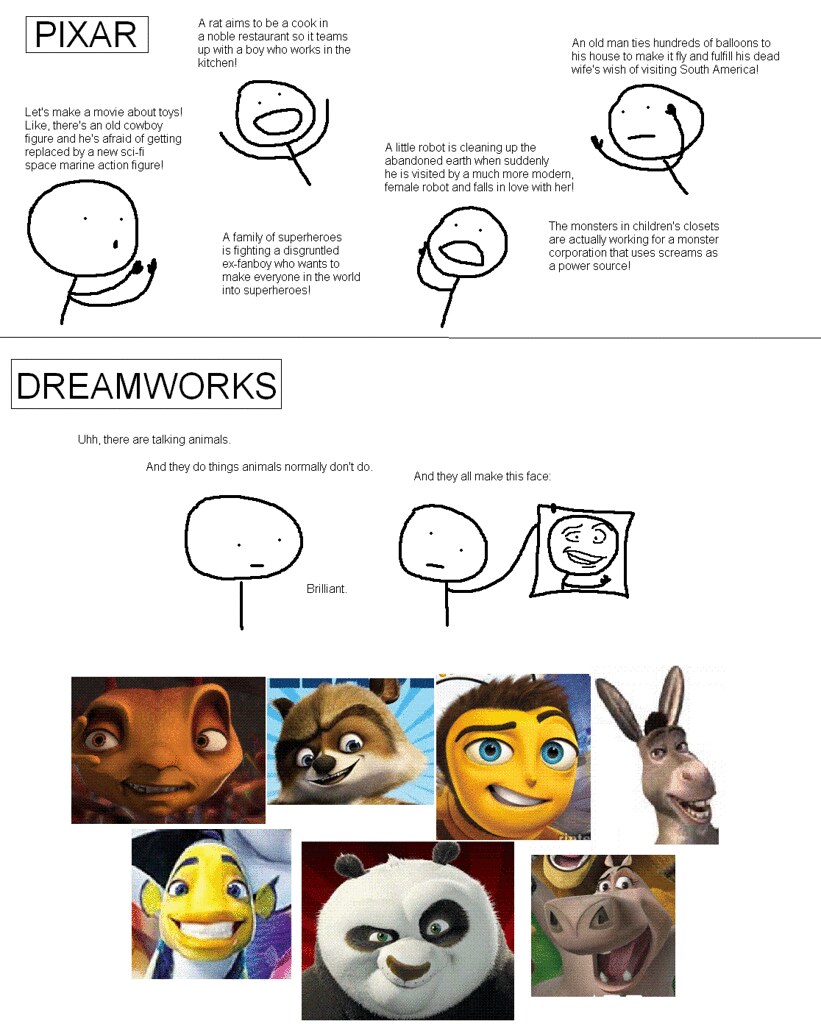
In case you needed another reason to check out our own The Gospel According to Pixar, I submit to you the following cartoon from poe-news:


It's funny because it's true. The Dreamworks formula is to get big name talent (Jack Black, Jerry Seinfeld, Will Smith, Eddie Murphy, and Will Farrell to name a few) to inflate a less than stellar story, while Pixar just keeps putting out Oscar winning movies.

Labels: , , ,

12.01.2010

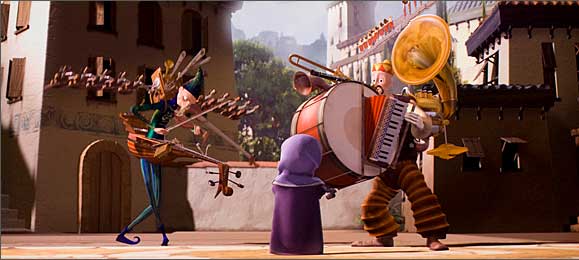
More Pixar! - Animated Short "One Man Band"

In case you haven't noticed, we at Mockingbird happen to be big fans of Pixar. The following comes from the Pixar short "One Man Band" (video below). For further reading, see our recently published book The Gospel According to Pixar.

The plot of "One Man Band" is fairly straightforward. A street performer, “Bass,” tries to persuade a young girl to give him her only coin. His light-hearted tune is interrupted by a new performer named Treble. With his fancy strings Treble wins the young girl away from Bass. The simple struggle over a single coin quickly escalates into a war. Without realizing it, each performer has turned away from the girl and only look at each other. They no longer try to charm the young girl with pleasant music, but each tries to outshine the other.

What we find in this short animated film is a simple, but powerful parable about the destructive nature of competition. The struggle between Bass and Treble frightens the girl, losing the coin (and a violin) in the process. The desire to win consumes each so that they can no longer recognize themselves or their surroundings. Instead of musicians holding instruments, they become brutes wielding weapons. Instead of playing a sweet sonata or a hearty march, their combined melody sounds like “Dreams of a Witches' Sabbath.” What's true of the short is true of life in general: any relationship containing competition will eventually end in defeat. The desire to be right or the need to assert your identity will ultimately kill any relationship (or church, for that matter!). Your rival can’t simultaneously be your spouse, parent, or child.

The parable hopes for an end to competition as the genesis of beautiful music. Musically-speaking, treble and bass represent the opposite high and low ends of audio pitch. The two are meant to be heard cooperatively in unison. The same can be said of our two street performers. Had they given up their desire to win and played together, they could have performed remarkable music. Instead of losing the coin altogether, they could even have been the beneficiaries of that large sack of coins.

True and loving relationships are founded upon the giving up all claims or demands for credit and recognition. In short, competition kills, self-giving love brings life.

In many ways this is an aural and visual demonstration of what Paul means in I Cor. 13:1 "If I speak in the tongues of men or of angels, but do not have love, I am only a resounding gong or a clanging cymbal." [Watch after the break].
[CONTINUE READING]

Labels: , , , ,

8.27.2010

The Gospel According to Pixar: Cars

The following post is another preview of the recent Mockingbird publication: The Gospel According to Pixar. To purchase your copy go here.

General Plot: Lightening McQueen is the new rookie race car on the block that is stealing headlines with every race. He’s super fast and he knows it. He’s a one man show and vocalizes it. When his pit crew ditches him, he doesn’t care…He’s headed to California to race the final race (between the King--the current Dinoco Spokescar--and Chick) to decide who will win the treasured Piston Cup and become Dinoco’s new spokescar. But on his way to California and a following a string of unfortunate events, Lightening McQueen finds himself on a barren stretch of road in a little town, Radiator Springs. In the midst of this misfit community, of eccentric cars--who do not know or care who Lightening McQueen is--Lightening McQueen will come to experience community and, thus, love, like he never could before being an island of one. The local Judge, Doctor, and former hot-shot race-car, Doc Hudson (aka The Hudson Hornet) will be swept up in McQueen’s experience; McQueen will force Doc to face his past, which remains desperately hidden, and encourages him out of hiding into community. This community and this love will significantly alter the way McQueen (and Doc) see life…to the point of sacrifice.

Gospel Plot:
“Oh, the places you’ll go! There is fun to be done!
There are points to be scored.
There are games to be won.
And the magical things you can do with that ball
will make you the winning-est winner of all.
Fame! You’ll be famous as famous can be,
with the whole wide world watching you win on TV.
Except when they don’t.
Because, sometimes they won’t.
I’m afraid that some times
you’ll play lonely games too.
Games you can’t win
‘cause you’ll play against you.
All Alone!
Whether you like it or not,
Alone will be something
you’ll be quite a lot”
Dr. Seuss, Oh The Places You’ll Go.

Dr. Seuss is right, alone is something we are quite a lot. We have all been alone. Like Lightening McQueen, we’ve either isolated ourselves intentionally by alienating others on our way to the top; or, unintentionally, like Doc Hudson, by keeping others at a distance, safeguarding our past failures and our present brokenness. Our plans succeed and we are abandoned, left alone, isolated by those who were once close to us; until…

Until something else happens, something meets us from outside of ourselves; even when we are trying like to heck to avoid this very thing.

Eventually we “break down” (McQueen) or we become “found out” (Doc). Being alone is not the final word. At that very intersection of success and brokenness, stands the message of one-way love. At that intersection stands the Cross. McQueen is not left alone, lonely at the top. Doc is not left isolated by his past failures. Something outside of both McQueen and Doc draws them out of themselves; and, thus, into community. Someone loves them by no merit of their own. Mater loves lightening McQueen for absolutely no reason but “just because”. This is one-way love. As Mater’s one-way love flows into McQueen, McQueen can finally love someone else beside himself (Sally, for example). When love is poured in, love pours out. McQueen renovates the town for Sally as a gift, but only after Mater loves him and calls McQueen his “best friend”. The entire band of misfits in Radiator Springs embraces McQueen, and McQueen in turn—against everything that McQueen had stood for—embraces them. And, in light of this one-way love, Doc is affected. Doc is confronted by McQueen and is drawn out of reclusion and back into community (and the spotlight!). McQueen and Doc have true friends and a true family that love them for no reason; and it’s a love that is neither merited by achievements nor conditioned by failures. Mater, Ramon, Flo, Sally, Guido, Luigi, Big Red (etc) love them “just because”, no strings attached.

The Cross: As with many Pixar movies it is not only about giving the audience a warm and fuzzy feeling at the end of the movie and some sort of implausible mandate: Now Go Love! Pixar never leaves us with a feel-good un-substantial ending. Nearly always, there’s one more scene to be played. One more message to communicate: one-way love leads to sacrifice. In the final scene McQueen is racing the best race of his life. He’s implemented the tricks he learned from Hudson, he’s got his best crew: his new family. McQueen is, literally, back on top and rather invincible. He is posed to defeat the annoying and conceited Chick. Everyone is rooting for him. As he is rounding the last turn toward winning his first Piston Cup, something terrible happens. The King has a devastating crash that renders him unable to cross the finish line of his last lap, of his last race, in his last Piston Cup.


(play video from 0.00-8.10) McQueen slams on his breaks, inches prior to crossing the finish line. A moment later Chick goes whizzing by and celebrates his win. Meanwhile, McQueen, still not crossing the finish line, backs-up and goes to King’s side. But it’s not to see if King’s okay; it’s to help King cross the finish line, to allow him the dignity of finishing his last race. McQueen sacrifices his career (he will even sacrifice the Dinoco spokes-car slot for his family of misfits) and comes in not second place but last…dead last. Pixar understands the power of love; and that the power of that love has an appropriate end: sacrifice. This is the Gospel message; this is the message of true, divine, one-way love; this is the message of the Cross. Through the sacrifice of Jesus Christ on the Cross, we, by faith, are no longer alienated from God, no longer alone, but are in communion with God himself (Col 1:19-22). The one-way love of Christ pours into us and, subsequently, out of us toward others. The church, the body of believers, ideally becomes the created community (out of/comprised of the broken, out of/comprised of the misfits) drawn together by this one-way love—from God for each-other. By one-way love, our possibility is given priority over our actuality (contra Aristotle). Our achievements and our failures no longer rule over us with condemnation—we are not defined by them but by God’s word: beloved; and this ‘word’ makes room for true and real transformation, it causes us to love others as we are loved.

Labels: , , , ,

8.19.2010

Toy Story as a Trilogy of Heroic Repentance, Part Three: Imputation, Salvation and the Theology of the Cross, Pixar-style

The conclusion to Jeremiah Lawson's AKA Wenatchee the Hatchet's brilliant and very touching look at the Toy Story trilogy. If you haven't read parts one and two, we highly suggest that you do so before reading this final part. To order a copy of Mockingbird's brand-new publication, The Gospel According to Pixar, go here.

When we look back on all the things Woody has said and done in the three films, we see that he could often be bitter, craven, wrathful, envious, fearful, and self-absorbed. Yet he has also become more selfless, more giving, more patient, more compassionate, and more the person Andy has imagined him to be over the three movies. By the end of this third film we can fairly ask whether Woody has become so because of his own capacity for embodying these qualities or whether he has also, to put it in starkly theological terms, been the recipient of imputed righteousness. In other words, has Woody been this good because he is this good or because years of being played with by Andy has given him these qualities? Clearly there is no need to assume a polarized assessment since both are true.

At the risk of putting things somewhat personally, I grew up the son of an American Indian man. I never liked movies involving cowboys and Indians. I never particularly liked how Indians have been betrayed in film whether it's been Dances with Wolves or the token Indian in Predator or Indian stand-ins in Avatar. Woody is the first and only cowboy character in my personal history with cinema that I can root for and relate to. Buzz says simply in Toy Story 2, "Woody once risked his life to save me and I couldn't consider myself his friend if I wasn't willing to do the same." Jesus, of course, said that there is no greater love than this that a man lay down his life for his friends.

There is a great deal that a Christian can appreciate about the Toy Story films and a great deal of character development consonant with the teaching of Christ. Of course this will never be a substitute for “the real thing,” but if your heart and mind are attuned to considering the story of Christ and His people, of the kindness the Father, Son, and Spirit bestow upon us as we await salvation, and most of all as we consider what it can look like to love God and our neighbor, stories like the Toy Story trilogy can inspire us to remember what we are urged to remember.

As I said at the start, those who consider Pixar villains to be weak links, storytelling-wise, are partly right. I believe David Denby has been correct to point out that, in contrast to Disney films that are psychological fables, Pixar films are moral fables--Pixar films have an almost civic-minded sense of duty to one's neighbor in them is roughly how Denby put it. Denby does not go so far as to say (but may as well have) that Disney films have traditionally depicted a central character cast in a faintly Randian narrative milieu struggling to love himself or herself and be admired by others.

The characters in Pixar films, on the other hand, struggle to realize that loving one’s neighbor as oneself does not mean somehow loving oneself more – in fact, loving oneself, as a goal, can actually hamper one’s ability to be loved. For example, Marlin in Finding Nemo does not realize that in protecting Nemo, he is protecting his own interests rather than acting as the best father he can be to his son. Bob Parr in The Incredibles does not realize that returning to a life of adventure without his family robs his family of a thing that can bind them together. Remy in Ratatouille must neither repudiate human or rodent society but recognize that his identity as a cook allows him to bridge both societies in a way that does not compel him to lie to either group. Of course, WALL-E sold us with the tagline that after centuries of doing what he was built to do, he was going to discover what he was born to do.

All of the above forms a narrative and character thread that goes all the way back to Woody and Buzz.
[CONTINUE READING]

Labels: , , , , ,

8.13.2010

Announcing The Gospel According to Pixar!!

Beginning with Toy Story in 1995, Pixar Animation Studios has taken American cinema by storm, setting a new standard of excellence in animated filmmaking and earning a fortune in the process. Their movies are not only highly entertaining but wise. Pixar has an all-too-rare gift for telling stories which speak about the reality of life and complexities of the human heart - and making us laugh while doing so.

Mockingbird's brand-new publication, The Gospel According to Pixar, looks at how each Pixar film portrays the basic concerns of everyday life and seeks to connect them with a Christian understanding of the world. Using imaginative stories about fish, monsters, and cars, Pixar films touch on such deeply human themes as love, identity, suffering, forgiveness, fear, freedom, guilt, purpose and belonging - to name just a few. These common concerns allow for easy avenues of dialogue between the films and Christianity, which The Gospel According to Pixar explores in hopes of communicating the Gospel in a fresh and persuasive way.

Written for a broad, all-ages audience, it can be used as a teaching series, a study guide, or simply as a commentary. And like the films themselves, we hope The Gospel According to Pixar is as moving as it is fun. Edited by Todd Brewer and David Zahl, and also featuring entries from blog contributors Bonnie, Nick Lannon and L.R.E. Larkin, we could not be more proud of it. The table of contents looks like this:
[CONTINUE READING]

Labels: , , , , , , , , , , , , ,

8.12.2010

Toy Story as a Trilogy of Heroic Repentance, Part Two: Prospectors, Prophets and Bears, Oh My

To kick off "Pixar Day" here on Mockingbird, we proudly present part two of Jeremiah Lawson's AKA Wenatchee the Hatchet's exclusive essay "Toy Story as a Trilogy of Heroic Repentance." The first part dealt with the nature of conflict in the Pixar masterwork (internal, not external) and Woody's role in the first film as a kind of prophet. This time around, WTH covers the central struggles in Toy Story 2&3, looking at identity, love, repentance and the lack thereof [spoiler alert]. As a side-note, since the essay was conceived as a whole, be sure to check in for the stunning conclusion next week, i.e. this one constitutes something of a transition between the intro and the conclusion - the body paragraphs, if you will. To order a copy of Mockingbird's brand-new publication The Gospel According to Pixar, go here.

The central struggle in Toy Story 2 is not that Woody will be replaced (by Buzz), but that Andy will cast him aside if he is broken. Andy is growing up and may no longer want to play with him. So Woody's great temptation in Toy Story 2 is to trade in his identity as Andy's toy (and the friend of Buzz and the other toys) for an alternate one: a rare collector's item. As we will see, the “whoever wants to save his life will lose it and whoever loses it will save it” (cf. Matthew 16:25) theme is once again powerfully present.

This time around Buzz plays the prophet role, reminding Woody of his real identity and who really loves him. Woody, having seen how his fears and envy caused so much harm in the first film, obviously does not take very long to have a change of heart. What tempts him is vanity or envy but his capacity for empathy. His empathy for Jessie's loss makes him want to stay with the Roundup gang. It looks right - like the right decision - but in truth, the path that appears to be right is a life of living behind glass and never being loved again. Buzz says, in so many words, there is a way that appears right but its end is ultimately death. Woody is quickly convinced and realizes that he has chosen a falsely. He repents, offering Jessie and Bullseye the opportunity to join him and return to Andy's house.

Of course, The Prospector won't have this and lays bare his motive: he hated spending decade after decade watching every OTHER toy get played with while he collected dust on a shelf. The envy that nearly destroyed Woody has completely consumed the Prospector and in the end, when the chips are down, his true character is revealed. The Prospector represents who Woody was becoming in the first film and what that it would look like if Woody had not turned from that path. What appears to be a punishment for the Prospector at the end of Toy Story 2 could, in an open-ended story, turn out for his salvation. We are not told what the ultimate fate of the Prospector is, but since the central conflict in a Pixar film is always internal, it is far less important to dispatch the titular villain to his or her death than it was/is in most Disney films.

By the third film, Woody is completely reconciled to Andy's faithfulness and goodness.
[CONTINUE READING]

Labels: , , , , , ,

8.04.2010

Toy Story as a Trilogy of Heroic Repentance, Part One

In celebration of putting our new The Gospel According to Pixar mini-book "to bed" (today! - look for an announcement next week) we thought we'd post the first of three installments that make up Mockingbird friend Jeremiah Lawson AKA Wenatchee the Hatchet's exclusive essay, "Toy Story as a Trilogy of Heroic Repentance." We've written about Toy Story on here before, but this really takes it to, you know, infinity and beyond:

One of the most illuminating criticisms of Pixar films over the last fifteen years has been that Pixar has rarely come up with compelling villains. The villain is either not particularly scary or not particularly necessary to the forward movement of the plot. This criticism misunderstands the nature of storytelling in most Pixar films. In Disney tales, villains can take the corporeal form (The Little Mermaid or The Lion King), or the villain can take a more social form, such as in Dumbo where the subtext in the film is racism and ethnocentrism and the effects that bias has on an individual and a family.

Any literature survey course will tell us that there are essentially three kinds of conflicts that drive a story: man vs man, man vs nature, and man vs himself. Include gender-adjusted and nature-adjusted variables as you wish. Pixar films are conspicuously low-key on man vs man as well as man vs nature but from the beginning Pixar films have reveled in man vs himself. The reason Pixar villains seem weak is precisely because the central conflict in a Pixar film is rarely between two primary characters. One might even go so far as to say that the weaker Pixar films are the ones that emphasize this man vs man conflict.

The strongest stories in the Pixar catalog have always been ones in which the central conflict for the central character is internal. Since noticing this tendency with Toy Story, I haven’t been surprised that people who prefer more conventional man vs man or man vs nature stories find Pixar villains disappointing. As a Christian, who sees a massive amount of the scriptural narrative as being one in which God's people are confronted with the reality that God is more for them than they are for themselves, I resonate with Toy Story on many levels. Our hero Woody is heroic not because he beats the bad guys but because he is on a steady path of repenting of his own biases and fears and how these biases and fears lead him to destroy others or diminish others.

Now that we have the third and probably final installment in Toy Story I think it is useful to point out that a full two thirds of the series has focused on internal conflict as the primary engine for storytelling. Woody is against Buzz Lightyear in the first film, to be sure, but the conflict arises because of his loss of faith in Andy's goodness and favor. He doubts that Andy will want to keep him and sees Buzz as the embodiment of his doubt in Andy's character. Buzz therefore must be considered the enemy; his delusions prevent Woody from realizing that he has a potential friend.

But the central conflict of the film has to do with Woody's fear that he has lost his role as Andy's favorite toy.
[CONTINUE READING]

Labels: , , , , ,

7.20.2010

The Gospel According To Pixar: Anton Ego's Conversion in Ratatouille

Another preview of our rapidly approaching new publication The Gospel According To Pixar. The following represents a portion of the addendum to the talk on Ratatouille (2007) entitled "Passion, Purpose and Pest-Control." Major spoilers ahead.

Brad Bird's Ratatouille is the story a rat named Remy who dreams of being a cook. And he gets that chance via the hapless Linguini, a down-on-his-luck janitor at the famous Parisian restaurant Gusteau. Through a convoluted series of events, Remy ends up directing Linguini's movements from under his toque, earning him a position as top chef at Gusteau's. Remy's cooking attracts the attention of the film's chief antagonist, the supremely cantankerous food critic Anton Ego, voiced by Peter O'Toole. From a Mockingbird perspective, very few characters in the history of film have represented the Law as purely as Anton Ego, so if you want to know what we mean when we throw around that term, look no further.

The following scene takes place at the end of the film. Ego has returned to Gusteau's to review the food, officially, and he has been kept waiting.


Eating the ratatouille, Ego has a conversion experience. The taste of the dish transports him back to childhood and reminds him of being taken care of by his mother. The food, in this sense, makes him feel loved. He abreacts – in a moment he is undone, his defenses penetrated - he is born again. We catch a glimpse of what Jesus meant when he said, we must become like children (Matt. 18:3). It is a profound moment.

Ego's closing speech is that of a converted man, the expression of a veil being pulled back. It is also a beautiful articulation of what we call "The Nazareth Principle": Good things coming from unexpected places, the ultimate of example of which being the carpenter from Nazareth. Not only is the cook unexpected, the ratatouille itself is an odd choice for a restaurant that serves haute cuisine. Similarly, the Christian Gospel is counter-intuitive. More often than not, it hits us sideways, in our blind spot. The vulnerable and needy place. We don’t expect it, so our defenses are not up. Thank God.

1 Cor 1:27 “But God chose the foolish things of the world to shame the wise; God chose the weak things of the world to shame the strong.”

Labels: , , ,

4.06.2010

The Gospel According To Pixar V: The Incredibles

As a preview of our forthcoming "Gospel According To Pixar" talk/study series - to be released at the NYC Conference next week - we thought we'd post a portion of The Incredibles entry. "(Secret) Identity And The Problem of Being 'Super'" looks at the subject of Identity in Brad Bird's masterpiece, and what follows is the Syndrome section. I like the Mr. and Mrs. Incredible material more, as their identities are considerably more multi-dimensional and mediated, but unfortunately those clips aren't on youtube... yet:

Plot Synopsis: Bob Parr and his wife Helen used to be among the world's greatest crime fighters, saving lives and battling evil on a daily basis, Mr. Incredible and Elastigirl. Fifteen years later, they have been forced to adopt civilian identities and retreat to the suburbs where they live "normal" lives with their three kids. Itching to get back into action, Bob gets his chance when a mysterious communication summons him to a remote island for a top-secret assignment. [Spoiler alert] His new employer turns out to be none other than his former fan-club president Buddy, now operating under the name 'Syndrome'. As a boy, Buddy had begged Mr. Incredible to let him serve as his side-kick, an offer which Mr. Incredible had adamantly turned down out of concern for the boy's safety.
[CONTINUE READING]

Labels: , , , , , , ,

2.05.2010

The Gospel According To Pixar IV: Monsters, Inc.

General Plot: Monsters, Inc. is about two monsters, Sully and Mike, who work for the Monsters, Inc company. Sully and Mike encounter a little girl, “Boo,” who has snuck into the Monster world from the human world via her closet door. Human children are considered a great health risk to monsters and could possibly cause death. Together, with a host of other monsters, Sully, Mike, and (the one of the villains) Randall work to collect “screams” from children. The more the monsters can make the children scream, the more energy they collect. This energy is what powers Monstropolis (Monster City, literally). Sully and Mike spend the whole movie trying to get her back to her world, keeping her safe from the evil intents of Randall and Mr. Waternoose, CEO of Monsters, Inc. During the process of trying to get Boo home safely, Sully discovers that Boo’s laughter is ten times more powerful than her screams. After Sully and Mike defeat Randall and Mr. Waternoose, Monsters, Inc., changes from a “scare” factory to a “laugh factory”.


[CONTINUE READING]

Labels: , , , , , ,

1.19.2010

The Gospel According To Pixar III: Finding Nemo's Resurrection

Continuing Mockingbird's fascination with all things animated (and anything even remotely related to uber-genius Brad Bird), we present The Gospel According to Pixar, volume 3. To read previous entries, see Volume 1: Wall-E, and Volume 2: Toy Story.

I'm planning a Sunday evening series for the next few months called "Jesus at the Movies" (stop by if you're in Jersey City)... so I've been spending a lot of time standing in front of my movie wall. I've ripped a bunch of clips from my collection, and am ready to start some good theological conversation. But I missed one. A parishioner asked me about the movies, listened to a few that I'd chosen, and then started talking about Finding Nemo. And he's right...FINDING NEMO!

Remember the scene where Marlin (Nemo's dad, played by Albert Brooks) and Dory (Ellen DeGeneres) are trapped in the mouth of the whale? Aside from the obvious Jonah parallels, there is a lot of good stuff goin' on in that whale's belly. First of all, Marlin tries to get out of the whale's mouth by pushing through the baleen plates (the toothbrush bristle-like stuff they have instead of teeth). See, he's trying by his own effort. He can't do it. He fails. His own effort fails him.

The water begins to drain from the whale's mouth, and neither Marlin nor Dory know what is going on. Dory, who "speaks whale," tells Marlin that the whale is asking them to "go to the back of the throat." Marlin, a notorious worry-wart, says, "Of COURSE he wants us to go to the back of the throat...he wants to EAT us!" Suddenly, Marlin and Dory find themselves hanging on to taste buds on the whale's tongue, with no water in the whale's mouth at all.


The whale makes a noise, Dory (who, remember, speaks whale) says, "Okay," and lets go. Marlon refuses to, thinking he'll be eaten...but Dory tells him that it's time...time to let go. Of course, this is a story point: Marlin has to realize that he's been holding on too tightly to his son. He has to realize that he can't protect Nemo from life. But the Christian parallels are actually pretty stunning.

Marlin, by his own effort, fails to escape from the whale's mouth. In the end, if he holds on to the taste bud, he'll die. There's no water in the whale's mouth. But Marlin THINKS that he has to hold on to live. The very thing he thinks is keeping him alive is killing him. He must let go, succumbing to "certain death" in order to be blown out of the whale's blow-whole, his life saved. We try to save ourselves by our own efforts. We try to "be all we can be." We can't. We keep trying, we hold on. This holding on, the thing that we think is saving us, is actually killing us. It is keeping us from our Savior. Letting go, giving up, and succumbing to certain death is the only way we can live.

If Finding Nemo supports the necessity of death and resurrection, who are we to argue?

Labels: , , , , ,

6.08.2009

The Gospel According to Pixar II: Toy Story

For those who haven't seen the movie (it is 14 years old!), Toy Story is a tale about the secret lives of Andy's toys. Whenever Andy leaves, a whole unknown toy world comes to life. This is a world of staff meetings, checker games, friends, and Plastic corrosion awareness meetings. Andy's favorite toy is Woody, an old pull-string cowboy. Woody enjoys a charmed life of love and personal prestige. Yet in one day he loses all of this as Andy is given a new Buzz Lightyear Space Ranger toy for his birthday. Woody is a character that has lost his place in life. Buzz has supplanted him as Andy’s favorite toy and Woody is discarded to the toy chest. But Buzz is oblivious of the benefits of being Andy’s favorite toy. He thinks that he is a real space ranger who needs to return to the mother ship.

There's so much to say about this movie: it touches the deep issues of loss, preaching and the nature of evil. But I want to highlight specifically the relationship between Andy and his toys as the pure Gospel message.

As demonstrated so clearly by Woody and Buzz, the toys derive their value externally through the love and attention of Andy. The most important thing in Woody's world is the place he holds in Andy's heart as his favorite toy. But as Buzz Lightyear's delusions demonstrate, Woody and Buzz are just toys. Woody isn't really a cowboy and Buzz really isn't a space ranger; Woody can't round up cattle and Buzz can't fly.

When Buzz is confronted by the shocking reality that he is a toy, he is thrown into despair. He says, "I'm not a space ranger. I'm just a toy, a stupid little insignificant toy." Yet Wood (the preacher) urges him saying, "Being a toy is a whole lot better than being a space ranger. . . Look, over in that house is a kid who thinks that you are the greatest. . . you are his toy." Buzz looks down on the sole of his boot and sees "Andy" written on permanent marker. Immediately, Buzz springs into action. He is saved from his despair through the assurance that he belongs to, and is loved by, Andy.

In the same way, our value is only found through being loved by God. As Luther said in the Heidelberg Disputation, "Rather than seeking its own good, the love of God flows forth and bestows good. Therefore sinners are attractive because they are loved; they are not loved because they are attractive... This is the love of the cross, born of the cross which turns in the direction where it does not find good which it may enjoy, but where it may confer good upon the bad and needy person."

To order a copy of our new publication The Gospel According to Pixar, go here

Labels: , , , ,

8.03.2008

The Gospel According To Pixar I: Wall-E

(Warning: Post contains spoilers, so don't read it unless you want to find out about scenes from the movie.)

I went to see Wall-E last week, and despite hearing numerous "You're going to love it!" from different folks I was still amazed by the movie. After creating some of the animated films I've most enjoyed in recent years, Pixar yet again blew my mind.

You can read about the plot of the story here, so I won't go into that in detail. The movie touched me for several reasons. One is the portrayal of one-way love from Wall-E to Eve. When she shuts down on earth due to completion of her probe for life on earth, Wall-E is a) not certain of whether Eve is even interested in him, although he might not have been sophisticated enough to consider the possibilities, and b) gives up his time, his mission, etc., to protect her. It sounds simple (maybe also simplistic), but I like how one-way love is simple. Wall-E, though sentient, is most likely not sophisticated enough to evaluate whether his gestures would ever be reciprocated. All he knows is that he likes Eve and wants to protect her. I like this picture of one way love and how it resonates with me; when portrayed in ways children can understand, it doesn't seem to have to "make sense" in grown-up terms, but it's just the way it is.

Another part of the story which I loved is how Eve, having become aware of what Wall-E was doing for her (through watching the video that recorded Wall-E's protective gestures towards her while she was shut down and inactive on earth, and having observed his persistence in ensuring the safety of the little plant, which he gave to her and was the reason that her directive was complete), realizes Wall-E's love. Not fully realizing what had happened, she begins to reciprocate. She doesn't really quite realize what's going on either; Wall-E is nowhere as sophisticated as she is as a robot, and what's really on her mind is her directive (to deliver the little plant to where it belongs). But somehow, she comes to understand (probably pre-consciously) what love is, and responds by being willing to give up her mission. I like this picture of love inspiring response from Eve, even before she was really aware of it; and it's Wall-E's love that inspires to be willing to give up the most important thing to her: which is her mission.

The third thing I really loved about Wall-E is how he is a little like a messiah figure (though that might be stretching it)--here's why. Everything that Wall-E touches becomes better. He shows another robot how to wave. Because of Wall-E, two humans actually begin to communicate with each other. He frees a bunch of broken, malfunctioning (though benign) robots and they follow him - and they help him. Out of love for Eve, Wall-E even sacrifices himself in order to ensure the success of her directive. He was crushed because of the robots who could not stop following previously given orders. Wall-E changed things and shook the paradigm a little bit like the way Jesus did.

And last, but not least, THE ANIMATION IS INCREDIBLE! I love the minmalist dialogue (mostly robotic sounds from the robots), and the sequence in space was just stunning. (Also, Wall-E reminds me a little of ET, probably because of the big eyes and long neck.) Also, he looks REAL. Here's a little blurb from the Wikipedia article about the creation of Wall-E:

After directing Finding Nemo, [Andrew] Stanton felt they "had really achieved the physics of believing you were really under water, so I said 'Hey, let’s do that with air'. Let’s fix our lenses, let’s get the depth of field looking exactly how anamorphic lenses work and do all these tricks that make us have the same kind of dimensionality that we got on Nemo with an object out in the air and on the ground'". Producer Jim Morris added that the film was animated so that it would feel "as if there really was a cameraman". Dennis Muren was hired to advise Pixar on replicating science fiction films from the 1960s and 1970s, including elements such as 70 mm frames, barrel distortion and lens flare."

Wall-E is up there along with the Chronicles of Riddick as one of my favourite movies of all time.

Labels: , , , , ,