3.30.2011

The Futility of "Out-Educating" Fat

Another insightful blurb on the failure of Pelagian-minded methodologies to solve the American obesity issue. According to Clotaire Rapaille, the "If Americans just knew more..." mentality seems to fly in the face of what's actually happening. Cited by Ramit Sethi (ht JD):

“Years ago, Tufts University invited me to lecture during a symposium on obesity…

Lecturer after lecturer offered solutions for America’s obesity problem, all of which revolved around education. Americans would be thinner if only they knew about good nutrition and the benefits of exercise, they told us. Slimming down the entire country was possible through an aggressive public awareness campaign…

When it was my turn to speak, I couldn’t help beginning with an observation. “I think it is fascinating that the other speakers today have suggested that education is the answer to our country’s obesity problem,” I said. I slowly gestured around the room. “If education is the answer, then why hasn’t it helped more of you?”

There were audible gasps in the auditorium when I said this, quite a few snickers, and five times as many sneers. Unsurprisingly, Tufts never invited me to lecture again.’”

Labels: , ,

3.15.2011

Fat Children Took My Life

A provocative piece on the obesity epidemic via Slate's new Hive project, in which author Daniel Engbar compiles a startling amount of data about the ineffectiveness of 'tough love' when it comes to dealing with this issue. In fact, the evidence of "the law increasing the trespass" (Romans 5:20) is pretty egregious here. A classic example of the civil use of the law (healthy weight being undeniably in the best interest of individuals and society as whole) backfiring completely, i.e. regardless of the intention, the law in this area is only ever heard/received in its moral capacity, therefore producing its opposite. At least, if the data is to be trusted... Take that, tiger mothers!

If it's really true that America suffers from a lack of tough love, and that's why we got so fat in the first place, then you might expect the nation's swelling obesity rates to have arrived on a wave of warm fuzzies. But we've seen just the opposite, says Rebecca Puhl of Yale's Rudd Center for Food Policy and Obesity (a leading advocate for the soda tax, among many other aggressive anti-obesity interventions). No one has been giving fat people a free ride. In fact, the prevalence of weight-based discrimination has increased by two-thirds since the mid-1990s; even middle-schoolers are getting meaner. The Hive tells us that to fight obesity we must "go on the offensive against obese people." Just look at the data. We tried that approach, and it didn't work.

As I've argued before, it could even be the case that all this stigma is making things worse. Columbia University epidemiologist Peter Muennig has found evidence that the life-shortening effects of obesity are more severe among women than men, and more severe among white women than black women. Women and whites also happen to be the two groups most affected by weight-based discrimination. According to Muennig, it makes sense that the more shame you feel as a result of being fat, the greater the toll on your body. So a widespread war on obesity, or indeed an effort to "fix" the nation's fat children, could serve to exacerbate the problem.

But you don't have to buy into the idea that fat shame is killing us. Research also shows that stigma doesn't help anyone slim down. Nor does it encourage healthy behavior (which is, after all, very different from weight loss). At the University of Minnesota, Dianne Neumark-Sztainer recruited nearly 5,000 adolescents for a long-term study of weight- and food-related issues, and according to her data, the teenage girls who were most dissatisfied with their bodies gained more weight over a five-year stretch than their classmates. In fact, these dissatisfied girls showed triple the increase in body-mass index, controlling for the possibility that they were fatter to begin with. All that self-hate didn't turn them into gym rats, either: The same group ended up getting less exercise than their peers.
[CONTINUE READING]

Labels: , , ,

3.11.2011

2.01.2011

The Ripped and the Righteous: The Gospel According to Jack LaLanne

Frank Bruni cooked up (!) quite the enlightening editorial in Saturday's NY Times about the recently deceased fitness guru Jack LaLanne, tracing the ways LaLanne was responsible for turning exercise into a religion, the gym into a temple, etc. I'll spare you a diatribe about the superficiality of "discipline" for discipline's sake - Bruni says/implies what needs to be said/implied - what's more interesting here is that although LaLanne may not have come up with the outside-in approach to self-improvement (that particular 'face' has been launching ships since the Stone Age), he was certainly instrumental in figuring out how to market it. It would seem he casts a shadow of Charles Finney-like proportions. I for one was unaware how explicit the movement was, from its outset, in co-opting religious language (ht AZ):

That sense of failure you feel when you haven’t exercised in days? That conviction that if you could pull off better push-ups, you’d be a better person through and through? These... are [Jack LaLanne's] doing, at least in part. What he left behind when he died last week, at the toned old age of 96, was not only a sweaty culture of relentless crunching and spinning but also the notion that fitness equals character, and that self-actualization begins with the self-discipline to get and stay in shape. In the post-LaLanne landscape, it’s not the eyes but the abdominals that are windows to the soul.

“There seems to be a whole substitute morality, where your obligation is to go to the gym and not ask why,” says Mark Greif, a founding editor of the literary journal n+1 and the author of a widely discussed 2004 essay, “Against Exercise.” “If you don’t, you become a sort of villain of the culture.”

The message that perspiration is a gateway to, and reflection of, higher virtues is captured in health club slogans like ones used by the Equinox chain over recent years: “Results aren’t always measured in pounds and inches.” “My body. My biography.” “It’s not fitness. It’s life.” The same idea is encoded in the language of personal improvement. A “new you” usually means a trimmer, tauter version, not someone who has learned to speak Mandarin or picked up woodworking skills.
---------------

In his own way, Mr. LaLanne was also a moralist, proselytizing about diet and exercise. To go back and look at his language is to be struck by its religious flavor.  He once compared himself to Billy Graham, saying that while Mr. Graham (no relation to Sylvester) was “for the hereafter,” he was “for the here and now.” He called what he was doing a crusade, adding, “To me, this one thing — physical culture and nutrition — is the salvation of America." And he admitted that exercise wasn’t always pleasurable or diverting. You did it because it was right and good and true — because it would better you. The Protestant work ethic pulsed through every one of his jumping jacks.
---------------

There’s a bullying strain to the modern fitness ethos, a blurred line between cheerleading and hectoring. And it’s hard not to wonder whether that kind of intimidation — in addition to the social and economic realities of diet and exercise — helps explain the paradox that for all the newfangled aerobic machines and reduced-rate January gym memberships, Americans aren’t noticeably haler and healthier.

When exercise comes wrapped in value judgments, does it wind up entangled in an anxiety that threatens the very resolve to get fit? As Mr. LaLanne was siring new methods for shaping up, he was fathering something else, too: a potent, and in some cases immobilizing, strain of contemporary guilt.

Labels: , , , , ,

1.31.2011

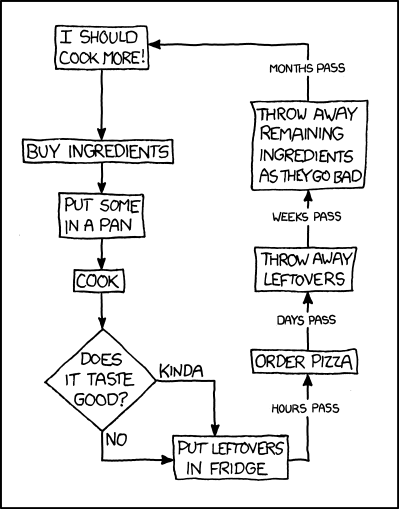
Learning To Cook

Another classic from xkcd:

Labels: , , , ,

1.21.2011

Another Week Ends: more Tiger Mom, Rex Ryan, Taco Bell, Dawn Treader, Downton Abbey, River Baptisms

1. The Tiger Beat goes on! David Brooks had some insightful things to say in The NY Times this week, calling Amy Chua a wimp:

Practicing a piece of music for four hours requires focused attention, but it is nowhere near as cognitively demanding as a sleepover with 14-year-old girls. Managing status rivalries, negotiating group dynamics, understanding social norms, navigating the distinction between self and group - these and other social tests impose cognitive demands that blow away any intense tutoring session or a class at Yale.

As a counterpoint, there's this post from Claire Potter which uses class/race language to articulate a lot of what we've been saying on here (and especially here) about the Law being the Law, regardless of its expression, i.e. whether it be actively or passively aggressive (ht CM). Another really interesting perspective comes from Ta-Nehisi Coates on The Atlantic. And that, as they say, is that - I declare a moratorium on Tiger Mother posts.

2. A couple of fun articles about obligation and our response to it. First, in The Onion, "Man Waiting Until His Parents Die To Do A Single Thing That Makes Him Happy." And then, in The Wall Street Journal, a story about a couple of Giants players unwisely confessing their desire to play for the antinomian Rex Ryan, ht WDR:

"I would love to play for guy like Rex," safety Kenny Phillips said. "He allows you to be you. He's not asking you to hide. If you're a guy that likes to talk, go out and talk as long as you back it up...these guys are playing for him. I'd love to be part of that."

"I think [the Jets] chemistry might be better than ours," said Mr. Phillips' Giants teammate, Antrel Rolle. "At the end of the day, we're professional athletes. We get paid a lot of money to do what we do, but we're human. No one is a robot at this level. We do have feelings. We like to have fun."

3. A laugh-out-loud report from the LA Times, "Menu Labeling Law Doesn't Register a Blip at Taco Bell".
[CONTINUE READING]

Labels: , , , , , , , , , , ,

11.02.2010

From The New Yorker

Labels: , , ,

10.12.2010

Me, My Oughts, and I

The penultimate installment in our series of entries from Judgment & Love, here is Bonnie's chapter. Again, J&L is a collection of 35 true-life stories illustrating the powerful truth that when love is shown in the face of deserved judgment, lives are changed. To order your copy at the reduced price of $10, go here or click on the button at the bottom of the post.

Like most teenagers living in developed countries, I worried about the way I looked. I knew I wasn’t fat, and even though I wasn’t quite as thin as some other girls, it didn’t really bother me at all since there were always other characteristics that made me feel good about myself—good grades, a lot of self confidence, a happy personality, and good friends. My body was never a very large part of my identity until I lived abroad and gained twenty-five pounds over six months. Somehow, that set off a siren in my head that something was not okay: I was “fat.” Not knowing what to do (and never having been on a diet before), I resorted to desperate measures to remove this “bad” part of my self-image: I developed an eating disorder.

According to Biological Psychiatry, 80% of women in the United States exhibit signs of an eating disorder at some stage; between 1-5% of adolescent women meet the criteria for diagnosis of an eating disorder, including an estimated 19-30% of college-age women. I became a statistic.

Some girls revel in their ability to manipulate how much they eat. When I was in high school, I remember a girl triumphantly told me she had only eaten three mints over an entire day; I thought that was the stupidest thing I had ever heard. Another girl told me about how to manipulate your throat to make yourself gag; that grossed me out. When I became desperate enough, however, these strategies seemed less strange and more “effective.” I thought I could stop once I had lost the twenty-five pounds. But I didn’t.

At this point you might say, “Oh, but you didn’t know better.” Of course I knew better. I was a Christian, and I knew my identity shouldn’t be determined by how I looked: I am “a child of God,” a “temple of the Holy Spirit,” and free from the bondage of sin and death. Children of God shouldn’t have to worry about mortal bodies that will eventually turn to dust. Temples of the Holy Spirit should certainly be presentable to the Lord. Christians who have been freed from bondage shouldn’t have obsessive- compulsive disorders. But knowing these things didn’t really change my behavior—in fact, it made me feel worse about myself. I would be reminded of my identity in God and the promise of God’s deliverance during my morning quiet time, and four hours later at lunch I would either not eat, eat too much, or count the calories in my salad with tuna (no dressing), and feel like a complete failure.

I talked to counselors and other Christians, had account- ability partners, read books, and prayed that something would change. I had already lost the twenty-five pounds, maybe more, and looked terrible. But I didn’t and couldn’t stop, and I hated myself for it. (I figured that God probably didn’t hate me, but He wasn’t going to be entirely happy with me until I shaped up.)
[CONTINUE READING]

Labels: , , , ,

6.04.2010

Obesity and the Bound Will

NEWS FLASH: there's a really interesting Mockingbird thread going on right now, started by Jeff Dean and Dave Browder, on a proposed tax on sugar sweetened drinks like Coke. It's already quite long -- take a look!

The thoughtful comments started by Herr Browder made me think of an extraordinary cover article in THE ATLANTIC a couple months ago called Beating Obesity. It touches on a huge number of things, including all the different public health strategies being considered -- one of which is the soda tax. But even more important it is written almost in the form of a personal essay and it has a touching awareness of the problem of the bound will and cruel judgment. Some excerpts from the article:

Putting individual solutions and free will up against the increase in portion sizes, massive technological and societal changes, food-company taste-engineering, and the ubiquity of effective television advertisements is like asking Ecuador to conquer China....

This jumble of circumstances and effects is what Thomas Frieden means when he says that just being an American can naturally lead you to be obese: obesity is an almost inevitable consequence of living with our cultural norms, our history of agricultural production and subsidies, our long-standing socioeconomic inequalities, and the impact of technology on our behavior and bodies. Against this formidable dynamic, America has erected two lines of defense: name-calling, and hectoring about diet and exercise.

For the average fat person, life can be an endless chain of humiliating experiences. On a flight to Denver not too long ago, I watched as a very large woman struggled to settle into her seat. Next to her, a much skinnier man curled his lip in disgust. The woman softly asked a passing flight attendant for a seat-belt extender. The flight attendant didn’t hear her over the roar of the engines, so the woman had to ask again, and this time, everyone looked at her. Grocery shopping, eating at restaurants, going to the movies, having drinks at a crowded bar—for the fat person, these are situations to be negotiated and survived, not enjoyed. The workplace is no different: a television executive once remarked to me that my career as a political analyst would “really take off if [I] would just lose a few pounds.” When I was fat, I avoided meeting people’s eyes. I didn’t want to subject them to my ugliness.

PS. This isn't the first time that this subject has come up at Mockingbird! Click here (and scroll down) to see a lot more.

Labels: , , ,

5.19.2010

Women, Food and God (and Oprah)

If you've been paying attention, you know that last week Oprah Winfrey announced that she's never dieting again. Her decision was apparently prompted by reading the book Women Food and God by Geneen Roth. I tend to tune out Oprah when it relates to anything religious or self-esteem-y, so I was definitely surprised to find some powerful (even familiar) ideas at work here, and ones that are by no means restricted to the fairer sex. From a post on the topic over at That's Fit:

Roth firmly believes that your relationship with weight is a disguise for your relationship with yourself. 

"We turn to food when we are not hungry because we are hungry for something we cannot name. A connection to what is beyond the concerns of daily life, something sacred. But replacing the hunger for a divine connection with Double Stuf Oreos is like giving a glass of sand to a person who's dying of thirst."

The more you recognize your inner problems, anxiety or discomfort, the better your relationship will be not only with food but of course with your soul.  You'll be happier, and the weight will fall off more naturally.
"You keep trying to feed yourself with that which cannot feed you," Oprah said. "I turn to food because if I deal with whatever it is I have to deal with in the moment, I'm going to fall apart."

Her words reminded me of a passage from Who Will Deliver Us? that Drake highlighted a while ago, about the Gospel in relation to the "assimilation of negativity":
[CONTINUE READING]

Labels: , , , , ,