12.16.2010

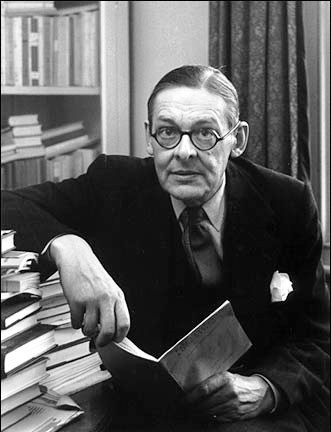
The Timeless God, an excerpt from T.S. Eliot

An excerpt taken from T.S. Eliot's "Four Quartets", "Dry Salvages":

To communicate with Mars, converse with spirits,
To report the behaviour of the sea monster,
Describe the horoscope, haruspicate or scry,
Observe disease in signatures, evoke
Biography from the wrinkles of the palm
And tragedy from fingers; release omens
By sortilege, or tea leaves, riddle the inevitable
With playing cards, fiddle with pentagrams
Or barbituric acids, or dissect
The recurrent image into pre-conscious terrors—
To explore the womb, or tomb, or dreams; all these are usual
Pastimes and drugs, and features of the press:
And always will be, some of them especially
When there is distress of nations and perplexity
Whether on the shores of Asia, or in the Edgware Road.
Men's curiosity searches past and future
And clings to that dimension. But to apprehend
The point of intersection of the timeless
With time, is an occupation for the saint
—
No occupation either, but something given
And taken, in a lifetime's death in love,
Ardour and selflessness and self-surrender.
For most of us, there is only the unattended
Moment, the moment in and out of time,
The distraction fit, lost in a shaft of sunlight,
The wild thyme unseen, or the winter lightning
Or the waterfall, or music heard so deeply
That it is not heard at all, but you are the music
While the music lasts. These are only hints and guesses,
Hints followed by guesses; and the rest
Is prayer, observance, discipline, thought and action.
The hint half guessed, the gift half understood, is Incarnation.
Here the impossible union
Of spheres of existence is actual,
Here the past and future
Are conquered, and reconciled,
Where action were otherwise movement
Of that which is only moved
And has in it no source of movement—
Driven by daemonic, chthonic
Powers. And right action is freedom
From past and future also.
For most of us, this is the aim
Never here to be realised;
Who are only undefeated
Because we have gone on trying;
We, content at the last
If our temporal reversion nourish
(Not too far from the yew-tree)
The life of significant soil.


[CONTINUE READING]

Labels: , , , ,

12.15.2010

“Wake me up inside…” (part 6): Karl Barth’s Doctrine of Reconciliation (iv.1.58) **final**

(iv.1.58.4 cont.) In a final turn, Barth deals with the dependence of the individual on community and the community on individuals; of the Christian on the Church and the Church on the Christian. For, “there cannot be one without the other”. The Holy Spirit assembles and sustains the Church, Christianity, not as a heap of individuals functioning autonomously, but as a collective of confessing persons proclaiming the same truths each cognizant of their individual calls; this is the delicate tension between the “objective ascription” and the “subjective appropriation” of salvation. “Salvation is ascribed to the individual in the existence of the community, and it is appropriated by the community in the existence of the individuals of which is it composed”.*

The work of the Holy Spirit as the basis for community of individuals mirrors the three parts of the doctrine of reconciliation. 1. By the power of the Holy Spirit, the awakening power of the Word (about the atoning work of Jesus Christ as the divine verdict) is the “historical reality of the community”. When the divine verdict is heard by persons, “in their inner fellowship and there arises in their outward assembly a new humanity within the old”. Each person, each Christian is brought into the awareness and acceptance of the divine verdict and they are brought into faith and understanding; however, it is not this that makes up a community. Rather, a community is created by the divine verdict of God, “it is not that they know God, but that they are known by God” and that these persons know and understand God in this way. In its humanity the church is like any other human institution: feeble and weak; yet under the divine verdict and sustained by the power of the Holy Spirit it will never cease to be. 2. By the power of the Holy Spirit, the life-giving power of the Word of God (about the atoning work of Jesus Christ as the divine direction) is the “inner upbuilding of the community”. “When that direction is heard by men, these men are united in a common action, in a common action oriented by a commonly imposed obedience, and, we can and must also say, by a commonly given freedom”. By the power of the Holy Spirit, the church is lifted up, maintained, sustained, grows, and quickened; in light of the divine direction, the members live into this direction (Jesus and the Holy Spirit) and thus to be truly active and alive. 3. By the power of the Holy Spirit, the summoning power of the promise (about the atoning work of Jesus Christ as the divine promise and guarantor) is the power by which individuals are brought into community and sent out as witnesses to the world. “The Holy Spirit is the enlightening, and as the enlightening the summoning power of the divine promise, which points the community beyond itself, which calls it to transcend itself and in that way to be in the truth the community of God” as witnesses to that truth of God. The members can hope in the divine promise and the end in Jesus. By the power of the Holy Spirit, by means of this hope, the Church community is the light unto the world and its members become witnesses of this light.
[CONTINUE READING]

Labels: , ,

12.09.2010

“Wake me up inside…” (part 5c): Karl Barth’s Doctrine of Reconciliation (iv.1.58)

(iv.1.58.4 cont.) *There are three forms to Sin. 1. Sin negates the first form of grace of God: that “God gives Himself to us, He makes Himself responsible for our cause, He takes it into His own hand”. Sin transgresses the great first commandment: Love the Lord your God with all your soul, mind, body, and strength. Sin negates that Jesus, very God, humbled Himself to become human in order to take humanity to Himself; thus, it negates Jesus’ High-priestly office; this is the sin of pride. 2. Sin negates the second form of the grace of God: that “He wills and seeks us as we are, in our creatureliness, as men, that we may be raised to the status of [His] children”. In this second form, sin negates the divine direction and the divine ordering, and elevates humanity in the place of God as true King. Thus, sin negates Jesus’ kingly office; this is the sin of sloth. 3. Sin negates the third form of the grace of God: that “God does not act above our heads, he does not ignore us, but He addresses us and calls us”. In this third form, sin negates the divine promise and lies to humanity that “they know better”. Thus, sin negates Jesus’ prophetic office (as the Guarantor); this is the sin of falsehood.

The reality of sin is true not in the sense of its own autonomous right, but as it is compared (or contrasted) or rather illuminated by the event of the divine “Yes” and “No” that is the event of the Cross. “The reality of sin cannot be known or described except in relation to the One who has vanquished it”. [In plainer words: we do not know we are really sinners until we see what has occurred in the event of the Cross.] Sin confirms Jesus as victor, because Jesus has the final word against it. “…the sinful No of man has been matched and opposed and destroyed by the divine Yes spoken by Jesus Christ even in the sphere of man and the world”. Jesus’ work of atonement is the victory of Jesus over sin. It is the “divine Yes” which has contradicted the “sinful no” of humanity, which is “maintained and fulfilled in the sphere of sinful humanity and sinful world”, and which vindicates “as the first and final word”. This tripartite understanding of reconciliation by Jesus Christ’s atonement lines up with the threefold grace of God (divine verdict, divine direction, and divine promise), the threefold nature of Christ (Jesus as God, Jesus as Man, and Jesus as God-Man), and the threefold being of humanity in Christ (faith/justification, love/sanctification, and hope/calling and teleological goal). In all three there is one common source, one common overlap, one common emphasis: Jesus Christ.
[Jesus] is the One who justifies, sanctifies, and calls. He is the High-Priest, King, and Prophet. In the whole event of atonement, justification, sanctification and calling, as grounded in the divine verdict, direction and promise, have as it were a central function. In them, in the understanding of grace under these concepts, it is still a matter of expounding the being and work of Jesus Christ as the Reconciler of the sinful world and therefore of sinful man with God.
In this tripartite (x3) understanding of reconciliation, humanity is dealing with not only what has occurred objectively in and by Jesus’ atoning work; but also with the subjective appropriation of the grace of God. In this subjective appropriation lie the gift, work, reception, and accomplishment of the Holy Spirit. The Spirit’s work is grounded in the teleologic orientation of the calling and work of Jesus Christ: as the Guarantor of truth. It is by the work of the Spirit that Christians are differentiated from non-Christians. While all maybe justified, sanctified, and called, not all have this distinguishing mark: that they can hear and see and understand all that and how God is for them, and what their true being is. By the power of the Spirit, sin is made known, need for something outside of the self is made known, hope is made known. “In this special sense Christians and only Christians are converted to him. This is without any merit or cooperation on their part, just as the reconciliation of the whole world in Jesus Christ is without its merit or co-operation”. By the power of the Holy Spirit and the work of Christ in the atonement the objective reality of humanity acquires a subjective reality. “[T]he same One and All is now in the eyes and ears and hearts, in the existence of these men, Christians, who are specially taken and determined by His Holy Spirit”. The Holy Spirit is by whom the whole of Christianity and all Christians exist.

*This is the second to last entry...and there was great rejoicing! :D

Labels: , ,

12.03.2010

“Wake me up inside…” (part 5b): Karl Barth’s Doctrine of Reconciliation (iv.1.58)

(iv.1.58.4 cont.) In the doctrine of reconciliation humanity is not only confronted with the positive side of the truths in Jesus Christ, but also the negative side of the truth of sin in the world initiated by humanity and its victim. By Jesus’ atoning work, God reconciles covenant breaking humanity to Himself by Himself. Consequently, the doctrine of sin is dealt with simultaneously and in conjunction to the doctrine of reconciliation. It is not of its own ontological identity as something that “exist[s] in and for itself” as a part of God’s creation; rather it is alien to the world (Rom. 5:12) and “exists and is in opposition to the will of God and therefore in opposition to the being and destiny of His creature”. Where God creates, sin destroys; where God says “yes”, sin says “no”; where God judges, sin serves. “In all its forms it exists and is only as that which negates and therefore as that which is itself negated, on the left hand of God, where God is saying Yes has already said No, where in electing He has rejected, where in willing He has not willed”. Sin is evil but it is also breaking the covenant and contradicting God, the rejection of the grace of God and therein the command to cling and the direction given; thus, sin is the denial of humanity’s true humanity.


Neither natural law nor a general idea of humanity can expose that humanity sins and transgresses and breaks the covenant with God. This fact and state can only be exposed by the Cross. The cross is the divine “Yes” to humanity in which lies the divine “No” to sin. The cross is the penultimate event that reveals humanity’s sinfulness. The Law fails to bring one to their complete understanding of their sinfulness, it is only by the Cross that one can be made perfectly aware of their transgressions against God and His covenant. Thus, the cross is The Law fulfilled, fully functioning in the way that the law was intended to do; the Cross is Law and Gospel. “It is in the knowledge of Jesus Christ as the revelation of the grace of God that we shall necessarily perceive step by step both the fact that man is a transgressor and the nature of the transgression in which the contradicts the grace of God and for the sake of which he is decisively contradicted by that grace”. Barth’s understanding of the cross as Law does not fully contradict Luther. While, yes, in Luther there is a stronger dichotomy between Law and Gospel, it is impossible to say that one can cleanly go through the bible and mark off “law” and “gospel” (cf. JDK’s Post here). There is room for an understanding that to some the Cross can be law: for it rejects the transgressor and causes condemnation but it also accepts the person. The Cross does illuminate our need and emphasizes our terrible state apart from it. Where Barth will differ from Luther in this regard is that Barth identifies the law with the earthly Jesus who is the paradigm of God’s holiness, rather than, as Luther does, identify the law with the Old Testament Law.*

*This was part of a critique offered to me by my professor for the class I wrote the paper for. Also, as a side note, my contention with Barth over Law/Gospel is that he doesn’t maintain the dichotomy between the two well enough; thus, the one could be confused for the other.

Labels: , ,

11.19.2010

“Wake me up inside…” (part 5a): Karl Barth’s Doctrine of Reconciliation (iv.1.58)

iv.1.58.4 Barth works out the threefold form of the Christological aspect of the doctrine of the reconciliation*. In and by Jesus, humanity is confronted with God. In Jesus, God—by becoming man—actively intervenes and takes up His cause—the covenant—“with and against and for man”. Jesus “is the authentic revealer of God as Himself God”. By Jesus one understands the Godhead because Jesus defines it and it does not define Jesus. “[Jesus] is God as he takes part in the event which constitutes the divine being” and He does this by becoming man. In this becoming man, God freely wills to condescend and bind and humiliate Himself in becoming like His creatures who are bound and takes them to Himself and takes upon Himself their penalty and judgment. “That is the nature and essence of the true God as He has intervened actively and manifestly in Jesus Christ”.

In the second form of the Christology of Jesus, humanity is confronted with God as Man, as human man. As a man, Jesus as God is subjected to the limitations as all humans are limited. He suffers as humans suffer. Just as He is fully God he is also fully Man (not part and part to create a whole). He is truly God as He is truly human and thus the triune God’s glory is in His humiliation. Yet, Jesus is a different human than we are, in that in His humanity He is the glory of God, and, thus, can be our mediator; but this must not be taken to consider Jesus as not fully human as we are: He is in complete equity with us. “To say man is to say creature and sin, and this means limitation and suffering. Both these have to be said of Jesus Christ…in correspondence with His true manhood”. His manhood is defined by Him, and Him alone. It is by His manhood that one knows true manhood: marked by suffering and limitation, yet exalted as the Godhead is humiliated. Jesus is fully God and fully man—two natures not two states—in His entire existence and the humiliation removes nothing and the exaltation adds nothing to Jesus Christ.
In Him it took place that while maintaining His true deity God became man, in Him to make His own the cause of man. In Him God Himself humiliated Himself—not in any disloyalty but in a supreme loyalty to His divine being (revealing it in a way which marks it off from all other gods). That is the secret of Christmas and Good Friday and the way which leads from the one to the other.
[CONTINUE READING]

Labels: , ,

9.03.2010

“Wake me up inside…” (part 1): Karl Barth’s Doctrine of Reconciliation (iv.1.58)

Karl Barth’s Doctrine of Reconciliation is the crescendo of the symphony that is his Church Dogmatics. Specifically, in this small (!) section (iv.1.58), one can begin to see how Barth is going to pull his entire theology together through the one moment, the one solitary and essential event of the atonement. He has woven together the previous three doctrines into this one doctrine of Reconciliation. IV.1.58 presents Barth at his absolute Christological best (and at his most un-universalistic). Barth’s doctrine of reconciliation not only emphasizes the triunity of God, but demonstrates how that triunity is expressed in God’s Grace toward humanity, in the being of humanity in Christ, in Jesus, in sin, and in individuality and community. Everything outside of the divine verdict, divine direction, divine promise, outside of faith, love, and hope, outside of Jesus as God, as Man, as God-Man, according to Barth, ceases and is negated; outside of Christ, humanity ceases to be humanity and becomes nothing (we’ll tease this out later). Barth’s doctrine of reconciliation puts fire into the desperate and needy sinner’s heart that burns so passionately, that they (I) can’t help but cry out,
“Save me from the nothing I’ve become!” This series is a mere attempt at summarizing what Barth said in this one section (iv.1.58), while communicating the same passion Barth communicates to his reader. This series will be an interaction with Barth’s train of thought and attempting to see the ways he links together the different parts as he does. In this series, I will simultaneously summarize and interact with Barth’s material and only Barth’s material (as in, I’m not incorporating those who have written on Barth); this is just Barth.

Labels: , , ,